Streetwear Tank Top Manufacturing: Building a Summer Capsule Drop
A summer capsule drop lives or dies on the tank top. The short answer: build it from a mid-weight jersey (180 to 220 GSM) cut in a relaxed or boxy silhouette with a dropped shoulder, finish it with garment-dye and wash effects for that lived-in depth, sell it as a coordinated set with matching shorts or joggers, release it on a small-batch cadence of 4 to 8 weeks, and ship it retail-ready with a woven label, care label, hang tag, and custom polybag. This guide walks through each step of streetwear tank top manufacturing for a summer capsule.
Relaxed vs Boxy Silhouettes for 2026
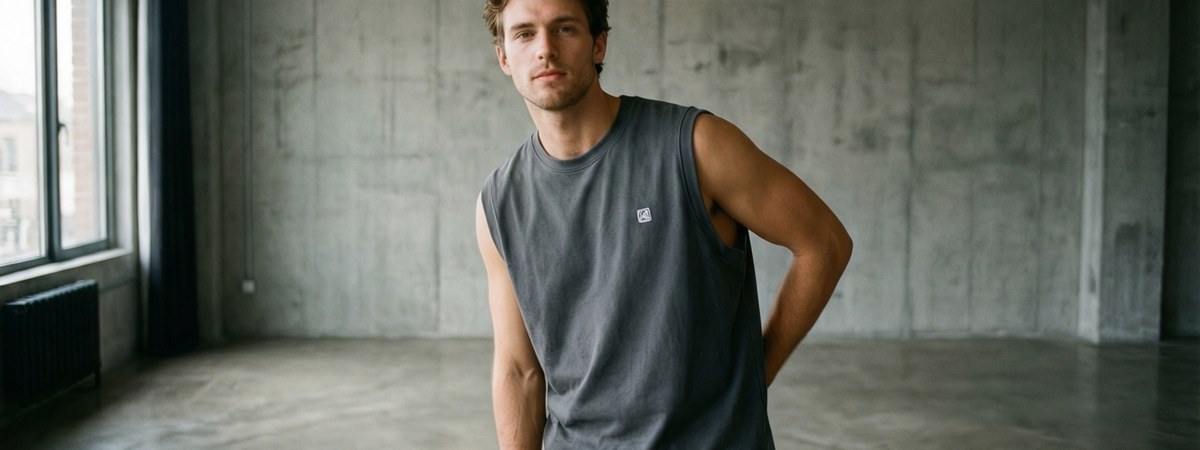
The silhouette is the first thing a shopper clocks in 2026, before the logo or the caption. Oversized is still in, but it has matured: the sloppy fast-fashion version is fading and what replaces it is more controlled, wider through the body with a dropped shoulder, but balanced by a cleaner drape and better proportions. Two terms dominate the brief. A relaxed tank keeps the shoulder seam near its natural line with extra room through the chest and waist, the safe entry point for a brand new to loose fits. A boxy tank uses a wider body with a slightly shorter or more structured line, so it reads deliberate rather than oversized-for-the-sake-of-it. Both rely on fabric weight to hold their shape; a thin 140 GSM jersey will cling and twist, while a 180 to 220 GSM knit drapes without collapsing into pyjama territory. Pick the silhouette first, because it decides the pattern, the fabric, and the wash.
The Pattern Math Behind a Good Tank Top
A tank top looks simple and that is exactly why the pattern betrays a weak factory. Drop the shoulder the right amount so the seam sits off the natural line without sliding toward the elbow. Curve the hem and add small side vents so the shirt moves with the body instead of riding up on a deadlift or a reach. Keep the neckline structured, a slightly tighter collar on an otherwise loose tank is what stops it reading as cheap or unfinished. Fabric weight carries the rest: most streetwear tanks land between 180 and 220 GSM so the body holds a boxy line through dozens of washes. A mid-weight combed cotton or a cotton-elastane jersey gives the soft hand a summer capsule wants, while a heavier 240 GSM only makes sense for a structured boxy statement piece. Grade the size run before bulk, because a boxy cut exaggerates a bad grade more than a slim one.
Garment-Dye and Wash Effects
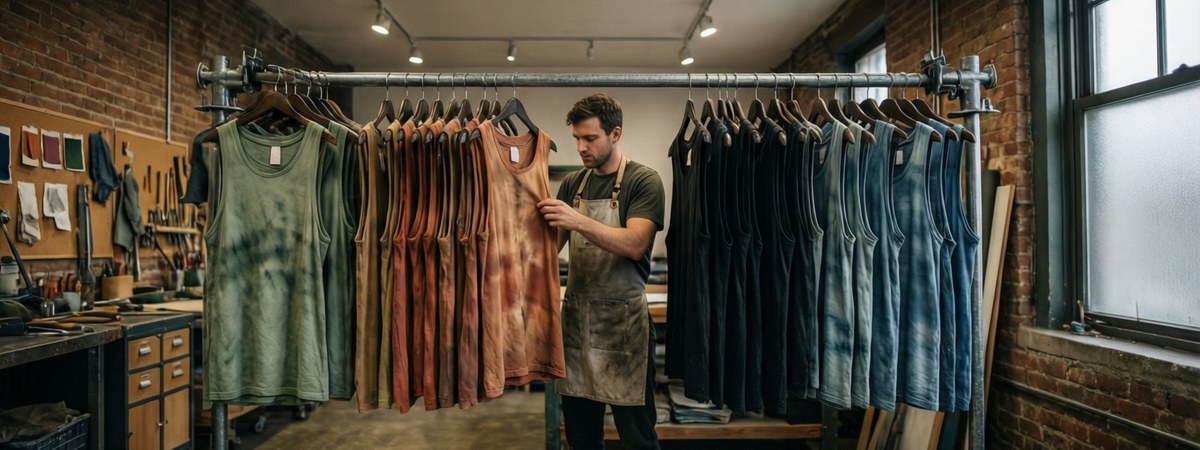
Garment dyeing is the single biggest lever for that premium, lived-in streetwear look, and it is a different production sequence from normal piece dyeing. In piece dyeing the fabric is dyed flat as yardage, then cut and sewn, which gives uniform color edge to edge. In garment dyeing the tank is cut and sewn first in greige or white, then the whole finished garment goes into the dye bath, so the seams, collar, and folds absorb color unevenly and you get subtle tonal variation, softer seams, and depth that flat color never has. The catch is shrinkage: because the piece is dyed and tumbled after assembly, the pattern has to be cut 5 to 8 percent oversized to land the right final fit, and shrinkage has to be tested at the factory rather than the mill. For a summer capsule that means you can test three or four colors in a small run without hitting a fabric color minimum, which is exactly why garment dye fits a drop model better than piece dye.
Enzyme Wash, Stone Wash, and Pigment Dye Compared
Each wash effect changes the hand-feel and the story. Enzyme wash uses cellulase enzymes at roughly 50 to 60 degrees C and pH 4.5 to 6.5 for 30 to 60 minutes to polish the surface and remove fuzz, giving a smooth, permanent softness with low water and energy use, the most sustainable of the three. Stone wash tumbles the garment with pumice or synthetic stones to abrade the surface into a rugged vintage fade, higher water and energy but a classic worn look. Pigment dye coats the surface with a resin-bound pigment rather than penetrating the fiber, so it reads matte and slightly uneven, softens over time, and gives that chalky vintage character streetwear loves. Sensorially, enzyme is the quiet premium finish, stone is the statement fade, pigment is the matte depth, and most capsule lines combine two, enzyme plus pigment being the common hybrid. Ask the factory for OEKO-TEX Standard 100 and ZDHC MRSL compliance on the chemicals so the wash is safe as well as good-looking.
Coordinated Sets With Shorts or Joggers
A tank top sells hardest as part of a set. The coordinated set, a tank paired with matching shorts or joggers, simplifies styling while maximizing impact, which is why it shows up across every 2026 summer streetwear edit. The proportion rule is one loose, one anchored: a relaxed tank with tapered shorts, or a boxy tank with slim joggers, so the outfit reads intentional rather than swallowed. For a summer capsule, match the tank to a 5 to 7 inch inseam short or a lightweight drawstring jogger in the same or a complementary wash, and let one accent piece, a cap or a crossbody, do the talking. The set also de-risks the drop: a customer who buys the tank alone still gets the look, and a customer who buys the set becomes a walking lookbook for the next release.

Building a Cohesive Color Story for the Capsule
A capsule is a small, related family, not a random pile of colors. Anchor it in neutrals that garment-dye beautifully: off-black, washed charcoal, ecru, sand, and a dusty sage or clay as the quiet accent. Keep the palette to three or four tones so every piece works with every other piece, which is what makes a capsule feel considered rather than chaotic. Washed and vintage tones do the heavy lifting here because they look lived-in from the first wear and they hide the natural variation of garment dye better than a flat bright. Add at most one louder accent, a washed burgundy or a faded offshore blue, reserved for a single hero tank so the drop has a focal point without breaking the cohesion. The color story is also your merch plan: lead with the neutrals, let the accent sell out first, and reorder into the proven tones.
Small-Batch Release Cadence
Streetwear runs on the drop model, and the cadence is the engine. Instead of keeping tanks in stock year-round, you release a limited quantity on a fixed date, sell out, and move on, which turns a product launch into a cultural event with built-in urgency. Emerging brands typically run 50 to 200 units per style on a 4 to 8 week cycle, while mid-tier brands step up to 100 to 500 units every 6 to 8 weeks. Monthly or bimonthly drops give your audience a reason to follow, check the site, and engage with every announcement, and each drop generates a predictable content pipeline: teasers, lookbook shots, behind-the-scenes footage, the drop day itself, and sold-out screenshots. For a summer capsule, a 6 week cadence lets you ride a trend while it is still hot, validate demand with a small run, and scale the winners into the next drop without a warehouse of dead stock.
From Sample to Sell-Out: Production Timing
Small-batch only works if the factory is fast. A disciplined capsule program samples in 7 to 15 days, then bulk runs 15 to 25 business days after approval, with low or no minimums so a first drop can be a single digit of pieces per colorway. That speed is the whole point: detect a micro-trend, develop the tank, and reach the market while the moment is live, something a 120 day bulk-only supplier cannot do. Build pre-drop awareness in the 5 to 10 days before release with email, short-form video, and a countdown, because a drop with no audience is just a small restock. Keep the permanent label architecture stable across drops so reorders match the first run, and reserve drop-specific storytelling for the hang tag where it is cheap to change.
Retail-Ready Labeling and Polybags
Retail-ready is product infrastructure, not decoration. Every customer-facing element has one job: the woven neck label carries the brand mark and size and stays with the garment for life, the care label carries fiber, origin, and care compliance, the hang tag carries the drop name, product story, SKU, and barcode, and the custom polybag carries the order identity and the unboxing moment. Treat them as a system pointing to the same sellable item, not four places to shout the logo. Keep the permanent neck and care labels stable so the product is identifiable after the campaign material disappears, and put the drop-specific story on the hang tag where it is easy to update. For a summer capsule, one consistent polybag plus accurate item labeling gives a small brand more control than several campaign mailers that create picking risk in the warehouse. Ask for a component-level quote, label development, trim, attachment, packaging, and storage are separate costs a per-piece price hides.
How MontForge Builds Streetwear Capsule Tanks
MontForge builds custom streetwear tank tops for summer capsule drops from 180 to 220 GSM jersey in relaxed or boxy cuts with a dropped shoulder, finished with garment-dye and enzyme, stone, or pigment wash effects for lived-in depth. Tanks are sold as coordinated sets with matching shorts or joggers, released on a 4 to 8 week small-batch cadence, and shipped retail-ready with a woven neck label, care label, hang tag, and custom polybag. Sampling runs in 7 to 15 days, minimums stay low so a first drop can be small, and every order is graded and inspected in stages so the reorder matches the first. Whether you want a three-piece neutral capsule or a louder accent hero, the build starts from the product page or a short brief, and the result is a tank that looks like your brand and drops like a drop.
Frequently Asked Questions
Relaxed or boxy, which should a first capsule use?
Relaxed keeps the shoulder near its natural line with room through the body, the safer entry point. Boxy uses a wider, more structured body for a deliberate streetwear statement. Both need 180 to 220 GSM fabric to hold their shape through washes.
What is the difference between garment dye and piece dye?
Piece dye colors flat fabric before cutting, giving uniform color. Garment dye sews the tank first, then dyes the whole finished piece, so seams and folds absorb color unevenly for a lived-in, vintage depth. Garment dye needs a 5 to 8 percent oversized pattern to absorb shrinkage.
Which wash effect is most sustainable?
Enzyme wash uses biodegradable cellulase enzymes at 50 to 60 degrees C for 30 to 60 minutes, giving permanent softness with low water and energy use. Stone wash is more resource-heavy, pigment dye sits between them, and enzyme plus pigment is the common eco-friendly hybrid.
How often should a summer capsule drop?
Emerging brands typically run 50 to 200 units every 4 to 8 weeks, mid-tier 100 to 500 every 6 to 8 weeks. A 6 week cadence rides a trend while it is hot, validates demand with a small run, and scales winners without dead stock.
What makes a tank retail-ready?
A woven neck label with brand and size, a care label with fiber and origin, a hang tag with drop name and SKU or barcode, and a custom polybag. Keep the permanent labels stable across drops and put the drop story on the easily changed hang tag.
Ready to build a summer capsule drop that looks like your brand and ships retail-ready? Send a brief and we will spec the silhouette, the wash, and the set, sampled in 7 to 15 days.