Coordinated Summer Shorts Collections for DTC Activewear
A coordinated summer shorts collection is not a few colourways of the same silhouette — it is a merchandising system where every pair earns its place against a specific activity, a shared fabric and colour palette, and a release plan that protects cash flow. For DTC activewear brands, the stakes are higher than for a single-SKU launch: split inventory, a colour that does not sell, or a restock that cannot match the first run will eat the margin the collection was meant to create. This guide covers how to build a shorts range by activity, the colour and fabric system that holds it together, the small-batch release cadence, the reorder and scale path, and the retail-ready packaging that completes it.
Building a Shorts Range by Activity
The collection should start from activity, not from aesthetic, because activity decides the construction and the customer. A strong summer range usually resolves into three or four roles: a training short with four-way stretch, a stable waistband and a secure pocket system for gym and functional fitness; a running short that is lighter, quick-drying and low-bounce, with a brief or compression liner; a 2-in-1 short that pairs an outer shell with an inner compression short for coverage and anti-chafe comfort; and a lifestyle or athleisure short in French terry or a soft cotton blend for rest days and street wear. Each role should be a distinct product with a distinct job — the most common mistake is repeating one silhouette in three colours and calling it a range. Match the first style to the brand's primary customer: a gym brand leads with the training short, a run-club brand leads with the running short, and a hybrid brand leads with the 2-in-1. We break down the construction of the first two in our guides to gym short inseam, liner and fabric choices and lightweight running short construction.
The Colour and Fabric System
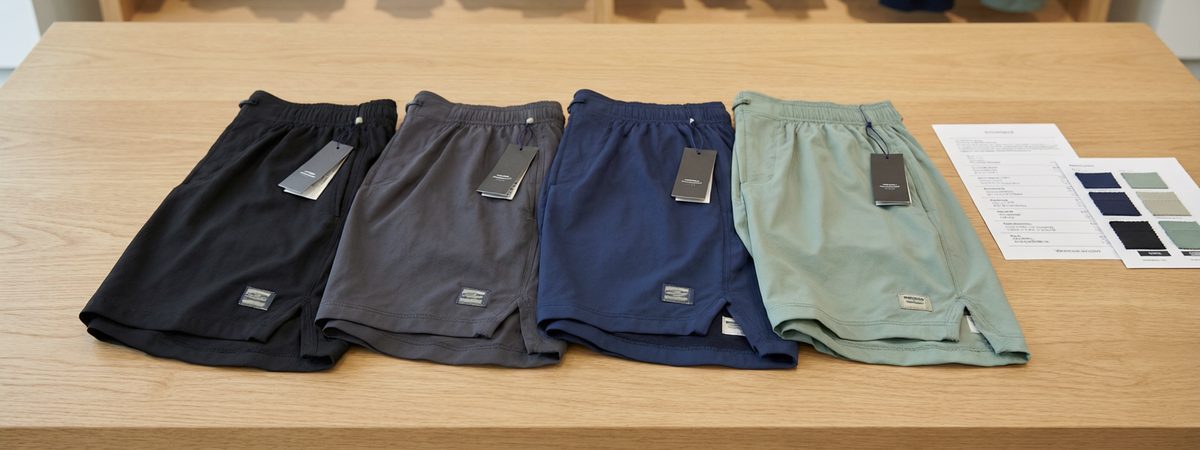
A collection hangs together when the colour and fabric decisions are made as one system rather than item by item. On colour, lead with a core of performance neutrals — black, charcoal, navy, dark olive and grey — that carry the repeat business, then layer one or two seasonal accent colours such as sage, clay, mist blue or a soft pastel to give the drop a summer feel. Black is the anchor: it is the highest-velocity colourway, generates the most reviews, and its buyers are purchasing for function, which gives the cleanest quality signal. On fabric, build a family rather than a one-off: a lightweight shell at roughly 120–180 gsm for running and hot weather, a midweight 180–250 gsm for premium training, and a heavier fleece or French terry for the lifestyle piece, all sharing the same liner fabric spec so the range feels consistent and reorders simplify. A polyester-spandex shell at 5–18% spandex delivers four-way stretch across the performance styles, and recycled polyester (rPET) satisfies the growing sustainability expectation. Lock the fabric and trim pack once, then roll it across every silhouette.
Small-Batch Release Cadence
Small-batch drops protect cash flow and generate data before you commit to volume. A proven first run is two to three colourways — black plus one neutral and one brand colour — rather than a broad launch. Brands that launch a first collection with a dozen colourways consistently report split-inventory problems and longer cash cycles; the prints and seasonal colours belong in the second run, once sales data shows which neutrals the customer actually buys. Structure the cadence as a sequence: launch the core neutral, use the first sell-through window to read velocity by colour and size, then release the seasonal accents as a second drop timed to the peak of the season. A low-MOQ manufacturer is what makes this cadence possible, because you are ordering short runs on a repeatable pattern instead of committing to a single large production order up front. Keep each drop small enough to sell through, and treat every drop as a data point for the next.

Reorder and Scale
The point of a coordinated system is that scaling becomes a reorder rather than a redevelopment. Once the pattern, fabric lot and trim pack are approved and archived, a 50–100 piece reorder on a repeat style is straightforward, and the main difference at higher volume is unit price rather than product. The discipline that makes this work is locking the source of every component: the fabric lot, the elastic, the drawcord, the labels and the thread are all recorded against the tech pack, so a restock in August matches the drop from May. Watch the two classic failure points — colour consistency across sizes, and fit drift when a new fabric lot is substituted — by re-approving a lab dip for any reorder and by sealing a reference sample. Scale the range by extending the same pattern block into a new silhouette (a cargo short or a coordinated top) rather than starting a new development each time, so the initial tooling and development cost keeps paying off.
Retail-Ready Packaging
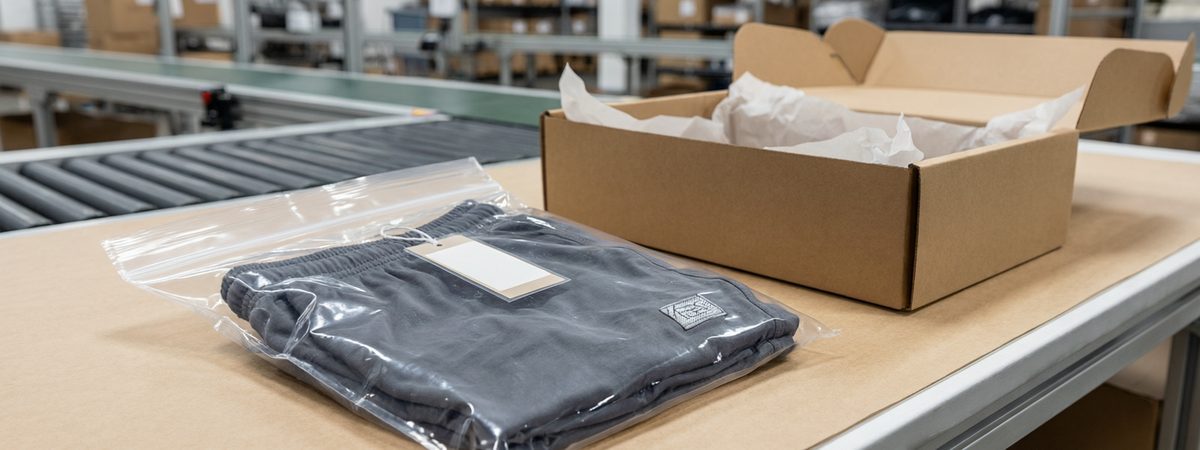
Packaging is the last touch the customer remembers, and for a DTC brand it is part of the product, not an afterthought. The standard is each piece folded and sealed in a clear polybag, with a woven label inside the waistband and a hang tag carrying the size, care instructions and brand story. For a coordinated collection, keep the hang tag and label design identical across the range so the set reads as a system when items are bought together. Specify the carton pack for retail or bulk, and for a DTC operation ask the manufacturer to pre-label cartons or split cargo to your fulfilment warehouse so the last-mile step does not introduce errors. Sustainable touches — a recycled polybag, a compostable mailer or a hang tag on recycled card — are now a differentiator rather than a novelty, and they cost little at the collection level. Packaging that matches the product's premium position closes the loop on a collection that started with a coherent activity, colour and fabric system.
MontForge DTC Shorts Collection Capabilities
MontForge manufactures coordinated summer shorts collections for DTC activewear and performance brands. We build the full activity range — training, running, 2-in-1 and lifestyle shorts — on a shared fabric and trim system, with lightweight to heavyweight shells, brief and compression liners, four-way stretch and recycled polyester options. Colour is managed as a system: performance neutrals plus seasonal accents with Pantone matching and lab-dip approval, so a restock matches the first drop. Low MOQ supports a small-batch release cadence, and archived tech packs with locked fabric and trim codes keep reorders and scale-up identical to the original run. Branding runs across woven labels, hang tags, prints and embroidery, and retail-ready packaging is specified to your fulfilment flow. One coherent system, from first drop to reorder.
Frequently Asked Questions
How many colourways should a first shorts drop have?
Two to three colourways is the right range for a first run: black as the anchor, one neutral, and one brand colour. Launching a dozen colourways up front typically causes split-inventory problems and longer cash cycles. Save prints and seasonal colours for the second run.
Which shorts style should a brand launch first?
Lead with the style that matches the primary customer: a training short for a gym brand, a running short for a run-club brand, or a 2-in-1 for a hybrid athlete brand. Starting with one clear product role is safer than launching several complex styles at once.
How do you keep a restock consistent with the first drop?
Lock and archive the fabric lot, elastic, drawcord, labels and thread against the tech pack, seal a reference sample, and re-approve a lab dip on any reorder. This keeps colour and fit consistent between a May drop and an August restock.
What fabric weight suits a summer shorts range?
A lightweight shell at roughly 120–180 gsm suits running and hot weather, a midweight 180–250 gsm suits premium training, and a heavier fleece or French terry suits the lifestyle piece. Sharing one liner fabric across the range simplifies reorders.
Why build a range as a coordinated system?
A coordinated colour and fabric system lets you scale by reordering repeat styles rather than redeveloping each time, keeps the collection visually coherent, and lets you extend one pattern block into new silhouettes so development cost keeps paying off.
Ready to build a summer shorts collection? Send us your range plan and fabric direction or browse MontForge custom shorts — coordinated colour and fabric systems, small-batch drops and retail-ready packaging at low MOQ.