Running Shorts Manufacturing: Lightweight, Split-Hem and Reflective Detail
A running short is not a gym short with a shorter inseam. It is a different garment built around three problems: weight on a moving body, chafing over long distances, and being seen by drivers in low light. The manufacturing decisions behind it — woven versus knit, ripstop reinforcement, split hem, liner construction and retroreflective trim — are what separate a race-day short from a promotional giveaway. This guide covers each, plus how race and marathon programmes specify them.
Why Running Shorts Are a Different Product
Training shorts prioritise durability and coverage; running shorts prioritise weight, airflow and freedom of stride. That single shift explains almost every construction difference. A runner's short is built as light as the fabric allows, with a split hem for stride room, a liner that moves without chafing, and a waistband that stays flat under a race belt. Where a gym short might use a mid-weight knit that resists barbell abrasion, a running short uses a lightweight woven shell paired with a soft knit liner — a construction formula you will find in most performance run shorts on the market, because each layer solves a different problem.
Ripstop and Woven Shell Benefits
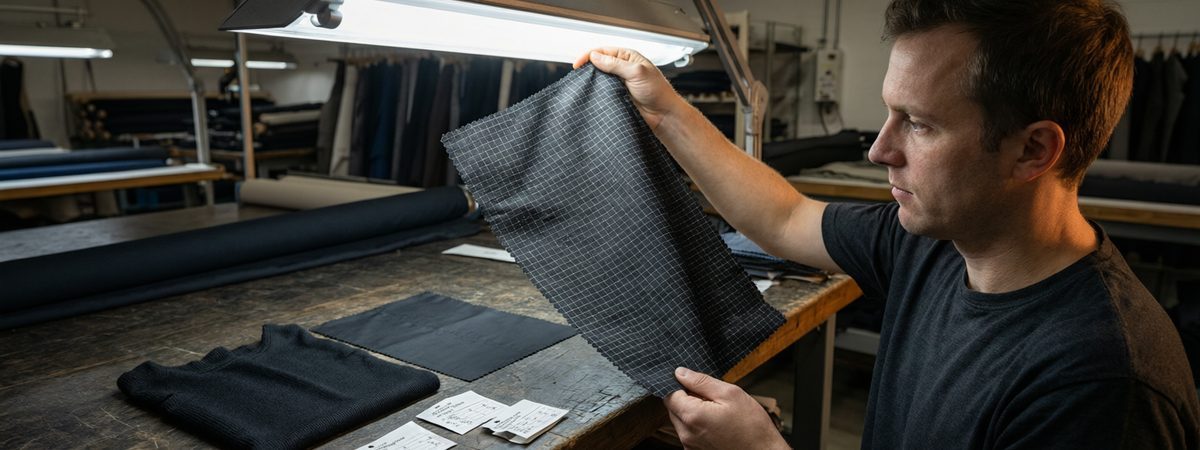
The outer shell of a running short is almost always woven rather than knit, and for good reason. Woven fabrics are built by interlacing warp and weft yarns at right angles, which produces a stable, wind-resistant, dimensionally reliable fabric that is lighter and more durable than a knit of similar protection — but with almost no stretch of its own, which is why spandex is blended in. A ripstop weave takes this further: thicker reinforcement threads are woven into a plain or twill grid at regular intervals, so any tear is contained inside a single grid cell (typically 5 mm to 8 mm square) instead of propagating across the panel. Two variables tune the performance. A tighter grid interval increases tear resistance at a small weight cost; a larger denier differential between the grid yarn and the base yarn raises tear-arrest strength at each node. For trail and mountain running shorts, a ripstop shell at roughly 80–100 gsm delivers abrasion and tear resistance at the hip, thigh and seat — the zones that meet brush, pack straps and falls — while staying light enough for ventilation. Nylon ripstop absorbs more moisture than polyester but is more abrasion-resistant, which is the usual trade-off to weigh; we cover the construction side in more depth in our guide to nylon ripstop and grid-weave fabrics.
The Woven Shell Plus Knit Liner Formula
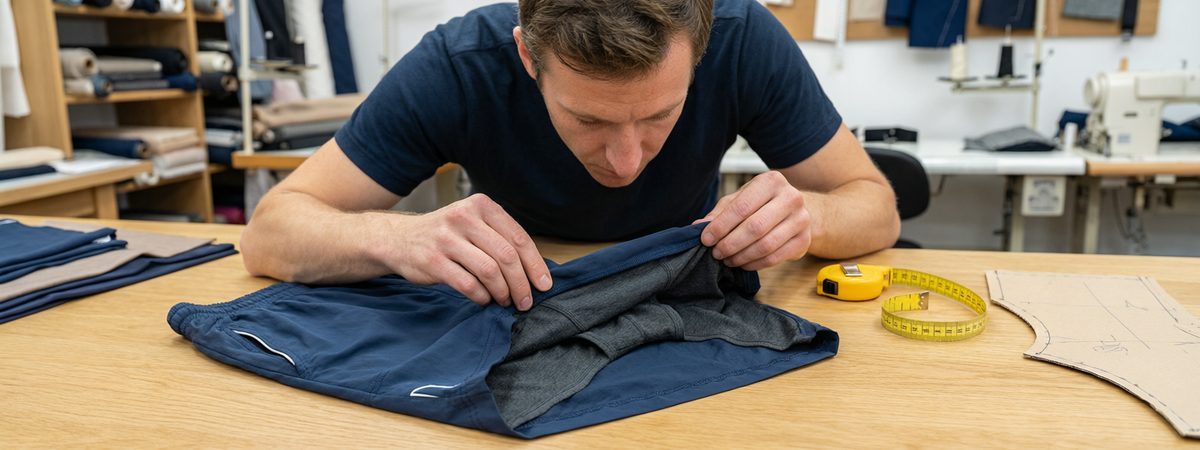
Because a woven shell does not stretch, the comfort has to come from the liner. Running shorts pair a woven outer (light, wind-resistant, structured) with a knit inner (soft, stretchy, moisture-managing), which is why the liner sits against the skin in a brief-like shape while the shell hangs loose around it. In a 2-in-1 or compression-lined short, the inner layer is a longer knit short that hugs the thigh; in a classic racing short it is a lightweight mesh brief. Getting the liner fabric right matters more than the shell in one respect: a scratchy or moisture-holding liner is the single most common cause of chafing, so specify a soft polyester or nylon knit with flatlock seams and minimal seam contact.
Split-Hem Construction
The split hem — a vertical opening at the side seam of each leg — is a functional detail, not styling. It releases the fabric as the leg swings, allowing a fuller stride and deeper hip flexion without the hem pulling, which is why short racing shorts commonly use a split hem. It also increases airflow at the thigh, the highest-heat zone on a summer run. Manufacturing-wise, the split needs a clean finished edge: a bound or bar-tacked opening that will not fray or tear after repeated washing, and reinforcement at the top of the split where the stress concentrates. On longer running shorts the split is often paired with a vent panel or laser perforations for additional airflow. Brief the split length explicitly — it is a spec, not a suggestion — and confirm it is reinforced on the sample.
Liner Options for Runners
Runners argue about liners more than any other spec. A brief liner is the traditional running choice: lightweight mesh, highly breathable, basic support, minimal coverage — ideal for hot weather and long distances where every gram and every degree counts. A compression liner is a longer, snug knit short that supports muscle, reduces oscillation, prevents chafing and typically carries a bounce-free phone pocket, making it the better call for speed work, HIIT-style sessions and runners who carry a phone. Boxer-brief liners sit between the two, and linerless shorts suit runners who prefer their own compression base layer. Whichever you specify, the liner decides chafe performance, so it deserves as much attention as the shell: flatlock or bonded seams, a soft wicking knit, and a wide flat waistband rather than a narrow elastic band that digs in over distance.
Fabric Weight and Blends for Running
Running shorts live in a narrow weight band because every gram matters on a moving body. Performance knits typically sit around 150–250 gsm, while lightweight woven shells run lower and feel sturdier for their weight thanks to a tight weave. The blends are well established: an 85–95% polyester with 5–15% spandex mix is the all-rounder for daily training, long runs and everything from a 5K to a marathon; a 75–85% nylon with 15–25% spandex mix is the lighter, silkier, faster-drying option for race day and hot-weather speedwork. Higher spandex content gives stretch and recovery; too little and the short feels boardy, too much and it loses structure. Always test recovery after stretching, and confirm opacity on dark colours — a black running short that turns translucent under tension is a return waiting to happen.
Reflective Safety Details
Reflective trim is the most under-specified feature on a running short, and the one with the clearest safety case. Retroreflective materials contain glass beads or prismatic elements that bounce a car's headlights directly back to the driver, rather than scattering light in all directions. The difference in detection distance is dramatic: in darkness a driver using low beams may see a runner in dark clothing at around 100 feet, giving under two seconds of reaction time, while retroreflective elements can extend detection to several hundred feet and raise reaction time into the range of 17–22 seconds. Placement matters as much as the material. Human vision is tuned to biological motion, so reflective elements on moving joints — ankles, knees and wrists — are recognised far more reliably than one static patch on the back, with research cited in the industry putting driver recognition at around 94% with joint placement against 67% without it. The ankles are prioritised because headlights illuminate them first and their rhythm is unmistakable. Reflective elements must be combined across at least two moving joints to multiply the signal, and they are distinct from fluorescent hi-vis colours: fluorescent pigment needs UV light to work, so it is nearly useless after dark without retroreflective trim alongside it. For buyers, ISO 20471 and ASTM F2960 give a reference framework for high-visibility expectations, and the useful sourcing data is the coefficient of retroreflection, wash-cycle retention, peel strength and application temperature range — ask for test evidence, not a brightness claim.

Technical Finishes Worth Specifying
Four finishes earn their place in a run-short programme. Antimicrobial treatment (silver-based systems are common) inhibits the bacteria that cause odour — sweat itself does not smell, the bacteria digesting it do. A hydrophilic finish improves wicking by encouraging capillary movement of sweat from the inside to the outer surface, and it is durable across washes when properly applied. DWR (durable water repellent) makes light rain bead and roll off for misty morning runs, though over-applying it reduces breathability. Laser perforations and mesh panels placed at high-heat zones — the back and sides — raise airflow without adding weight. Pair these with a wide knit waistband that wicks rather than a narrow elastic band, and internal drawcord security for race conditions.
Race and Marathon Use
Race apparel adds a layer of specification on top of training gear. Marathons and organised races mean race bibs, timing chips and, in many events, mandatory or strongly encouraged visibility kit for early-morning starts. Practical requirements for a race short: a secure internal key or gel pocket that does not bounce, a flat waistband that does not interfere with a bib belt, a hem and liner that stay put through 42 kilometres of sweat, and reflective trim for the pre-dawn corral. For event and club programmes, the same run short usually doubles as merchandise — so size runs, colour matching to the event palette, and branding that survives repeated washing matter as much as the race-day spec. Specify the decoration method against the fabric: sublimation is permanent on polyester, while reflective trim needs to be integrated into a seam or applied as a low-profile film so it keeps its stretch and does not curl at the edges.
MontForge Run-Short Capabilities
MontForge manufactures custom running shorts for performance, running and CrossFit brands. We build lightweight woven shells — including ripstop nylon and polyester constructions at 60–100 gsm — paired with knit brief and compression liners in polyester or nylon-spandex, with split hems, vent panels, laser perforations, wide knit waistbands, internal drawcords and secure pockets. Reflective trim is integrated as seam tape or low-profile heat-transfer film, positioned on moving joints for maximum biomotion visibility, with wash-durability data provided against your required cycle count. Finishes include antimicrobial, hydrophilic wicking and DWR, and branding runs across sublimation, screen print, heat transfer and embroidery with Pantone colour matching. From a 50-piece club order to a race programme, we help brands make shorts that are light on the body and visible in low light.
Frequently Asked Questions
Why do running shorts use a woven shell instead of a knit?
Wovens are lighter, more wind-resistant and more dimensionally stable than knits at similar protection, which suits a garment where weight and airflow matter. They have little natural stretch, so spandex is blended in, and a knit liner provides the soft, stretchy layer against the skin.
What does ripstop actually do?
Ripstop weaves thicker reinforcement threads into a grid at regular intervals, so a tear stops at the nearest grid cell — typically 5–8 mm — instead of running across the panel. A tighter grid interval and a higher denier differential both raise tear resistance. Trail and mountain shorts commonly use an 80–100 gsm ripstop shell.
What is a split hem for?
It is a functional opening at the side seam that releases fabric as the leg swings, allowing a fuller stride and better airflow at the thigh. It needs a bound or bar-tacked edge and reinforcement at the top of the split so it survives repeated washing.
How much does reflective trim actually improve visibility?
Retroreflective elements bounce headlights back to the driver, extending detection distance from roughly 100 feet for dark clothing to several hundred feet, and reaction time from under two seconds into the 17–22 second range. Placement on moving joints — ankles, knees, wrists — is recognised far more reliably than a single static patch.
What fabric blend should I spec for running shorts?
85–95% polyester with 5–15% spandex is the all-rounder for daily training and long runs; 75–85% nylon with 15–25% spandex is lighter and faster for race day and hot weather. Always confirm stretch recovery and check opacity on dark colours.
Ready to build a running shorts line? Send us your race spec or browse MontForge custom shorts — ripstop shells, split hems and biomotion reflective trim at low MOQ.