How to Build a Coordinated Tracksuit Line from Tech Pack
A coordinated tracksuit is really two garments that have to read as one product, and the tech pack is the document that holds them together. When the jacket and pant are briefed as two separate garments with no shared rules, they drift apart during sampling — the shades stop matching, the grading stops aligning, and the set falls apart visually even when both pieces pass inspection individually. This guide walks through syncing the jacket and pant spec, building a colour and stripe system, sampling both pieces, fit approval, and bulk and reorder.
Structure the Tech Pack in Two Layers
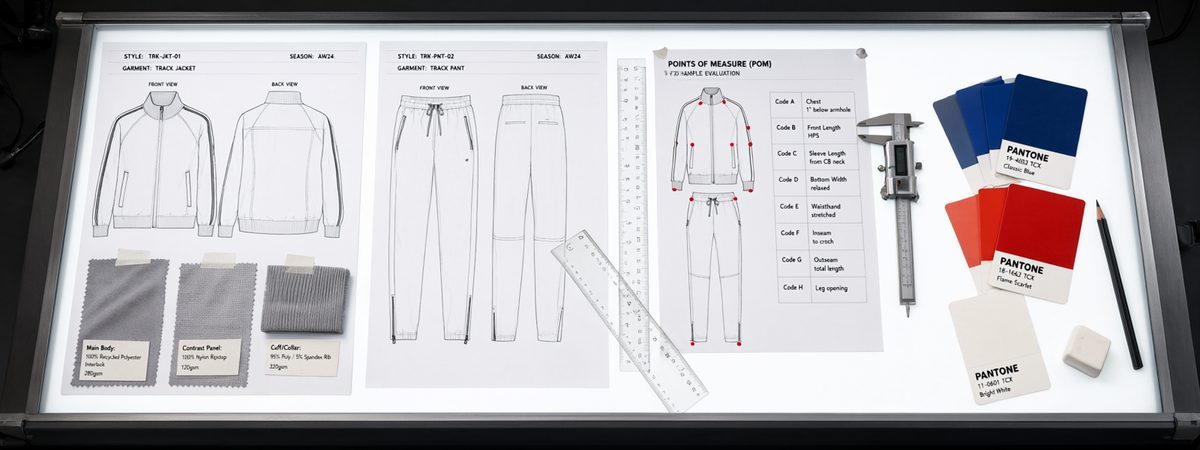
A matching-set tech pack needs a dual-layer structure: individual garment data for the jacket and the pant, connected by a shared rule layer that keeps them synchronised. In layer one, separate the top and bottom — a flat sketch and measurement chart for the jacket, and one for the pant — so a pattern maker never mixes the two measurement systems. In layer two, lock the shared rules that make them one set: the same fabric lot and GSM range, a single Pantone colour standard, a unified shrinkage tolerance, and aligned grading logic. Without that second layer, the top and bottom evolve independently and pass inspection individually while failing as a set. The five things a complete tech pack must carry are a flat sketch with callouts, a points-of-measure spec sheet, a bill of materials, Pantone references, and vector artwork files.
Build the Colour and Stripe System
Colour is where matching sets fail first, so define it as a system, not a word. Specify every colour as a Pantone TCX reference, not "navy" or "teal", and approve it on a lab dip — a small swatch of the actual bulk fabric dyed to target — evaluated under D65 daylight, with a second check under A-light to catch metamerism, the effect where two colours match in one light and split in another. The side stripe is the set's identity: specify it as sewn-in tape, contrast piping or a cut-and-sewn panel, and fix its width, colour and position so it registers identically on the sleeve and the outer leg. Approve colour on the real fabric structure too — a body fabric, rib collar and cuff can reflect the same dye differently. For the bottoms half of this logic, see our guide to coordinated tracksuit bottoms.
Sample Both Pieces Together, Not Apart
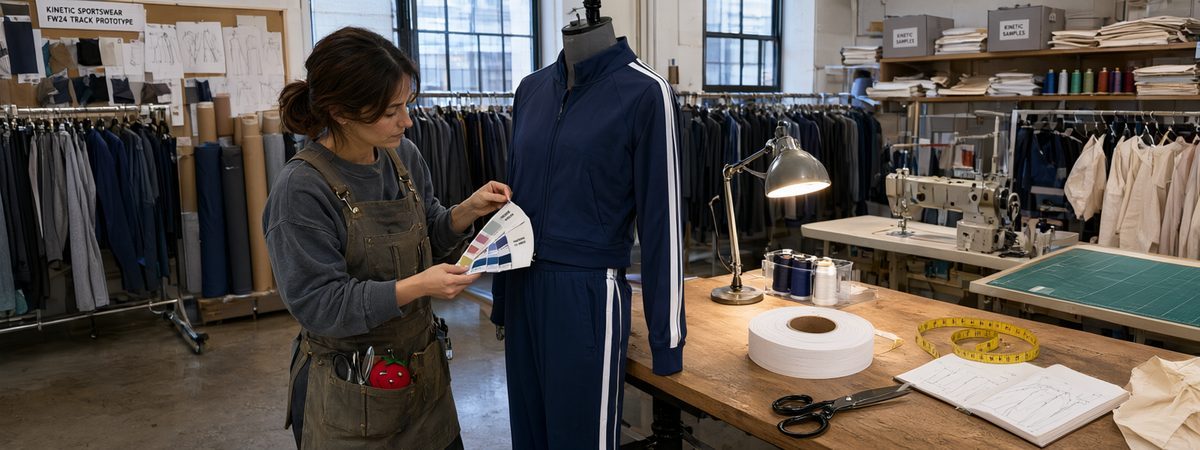
Sampling a set follows a fixed sequence: a proto sample to confirm construction, a lab dip to confirm colour, a fit and size set to confirm measurements across all sizes, a strike-off to confirm print or embroidery artwork, and finally a pre-production (PP) sample in the approved fabric and trims. Sample the jacket and pant together as a complete set, not as isolated pieces, because a jacket that fits and a heavier pant that restricts movement make a combination that fails on a body even when both pass in isolation. A well-specified tech pack reaches PP approval in about two rounds; an underspecified one runs five or six and adds four to eight weeks to the timeline.
Fit Approval: Sign Off the Worn Set
Approve the set on a body, not on a spec sheet. Fit the jacket and pant on the same size wearer and check reach, sitting, walking, waistband comfort, sleeve length and ankle opening — a coordinated set should look balanced without restricting movement or adding bulk under the jacket. Confirm the size pairing too: many programmes need a different size ratio in tops and bottoms, so specify a size breakdown per piece and confirm whether buyers can order mixed jacket and pant sizes. Set tolerances in writing — critical points at ±0.5 cm, general points at ±1.5 cm — and sign the PP approval letter, because that sealed sample becomes the contractual reference for bulk inspection. On the silhouette decision underneath the fit, see our guide to slim European vs vintage American tracksuits.
Bulk and Reorder: Hold the Standard Across Every Run
Bulk inspection is a comparison, not a judgement in a vacuum. Inspect finished units against the sealed PP sample, checking colour match between top and bottom on every unit, rib rebound, drawcord function and seam strength, to AQL 2.5 — the industry-standard defect threshold. Then make reorder easy by archiving everything that controls consistency: the dye formula and dye lot record, the pattern and grading rule, the colour code, and the decoration execution settings (thread colour, stitch density, print ink and cure). A brand that keeps that file on hand reorders at the same shade and fit six months later with no re-sampling, because the archived spec becomes the reference for every future run.
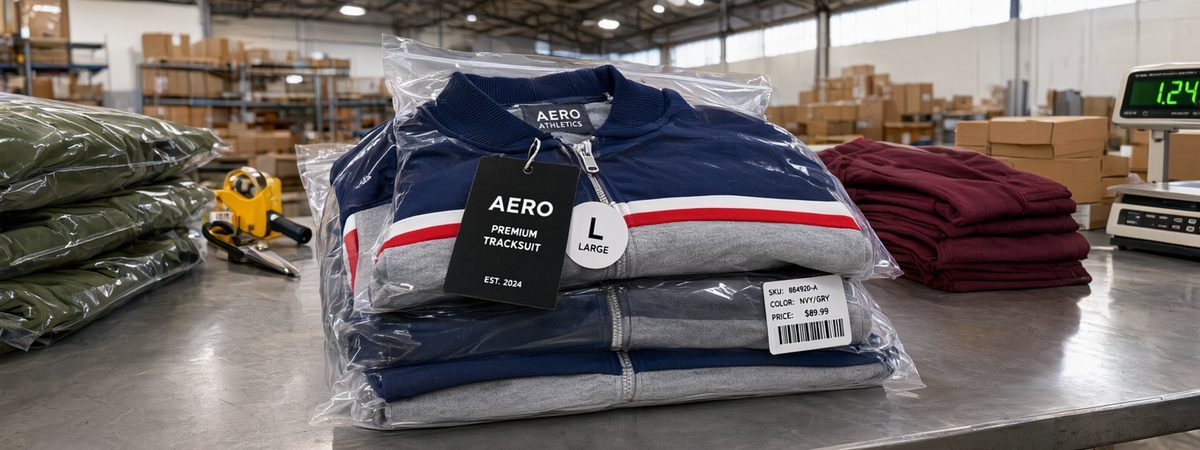
A Coordinated Line Checklist
- Structure the tech pack in two layers: separate garment data plus shared fabric, colour and grading rules.
- Specify every colour as a Pantone TCX reference and approve it on a lab dip under D65 light.
- Define the side stripe as tape, piping or a panel, fixed on both the sleeve and the outer leg.
- Sample the jacket and pant together as a complete set, then approve the worn combination on one wearer.
- Sign the PP approval letter with written tolerances — it is the contractual bulk reference.
- Archive the dye formula, pattern, colour code and decoration settings for shade-stable reorders.
Frequently Asked Questions
How do I keep a tracksuit jacket and pant matching?
Brief them with a shared rule layer — the same fabric lot and GSM, one Pantone standard, a unified shrinkage tolerance and aligned grading — and cut both from one dye lot on one line. Colour mismatch almost always comes from the two pieces being made from different lots.
What should a matching-set tech pack include?
A flat sketch with callouts, a points-of-measure spec sheet, a bill of materials, Pantone references and vector artwork files, structured as separate jacket and pant data connected by shared fabric, colour and grading rules.
How many sampling rounds does a set need?
A well-specified tech pack reaches pre-production approval in about two rounds. An underspecified brief can run five or six rounds, adding four to eight weeks and significant cost.
How do I approve the fit of a coordinated set?
Fit the jacket and pant on the same size wearer and check reach, sitting, walking, waistband comfort, sleeve length and ankle opening, then sign a PP approval letter with written tolerances.
How do I keep reorders consistent?
Archive the dye formula and lot record, the pattern and grading rule, the colour code and the decoration settings, then reorder against the sealed PP sample so every run matches the original.
One brief, one matching set, every run. Explore MontForge custom tracksuits or send us your tech pack — two-layer specs, a locked colour and stripe system, set sampling and a shade-stable reorder programme.