Down Jacket Manufacturing: Down vs Synthetic Insulation
For brands planning down jacket manufacturing, insulation is a connected sourcing and product-development decision. Comparing down vs synthetic insulation means looking beyond a fill-power label: the filling, shell, construction, moisture exposure and evidence all need to support the jacket’s intended role.
Choose Insulation Around Your Collection Brief
Share the intended use, target weight and sourcing requirements to discuss suitable development options.
Start With the Intended Product Role
Choose insulation around the jacket’s job: a compact layer carried for stops, an everyday winter outer layer or a garment intended for repeated activity in damp weather. Define the layers worn beneath it, the equipment carried and how often it will be packed or washed.
Down and synthetic insulation both retain air within a structure that limits heat loss. Their practical behaviour depends on material quality, quantity, construction and condition. Avoid choosing from a product-category label alone.
A custom down jacket manufacturer needs this use case before recommending fill and chamber layout. For a synthetic alternative, ask the team to confirm available insulation references and suitable construction for the project. A comparison should describe two complete proposed garments, rather than contrasting a premium down option with an unspecified generic fibre.
Compare Down vs Synthetic Insulation as Complete Garments
Down often suits briefs where low carried weight and compact storage are priorities. Synthetic options can be attractive where damp exposure, frequent care or a particular construction format matters. These are starting considerations rather than guaranteed results for every material.
| Buyer priority | Down proposal | Synthetic proposal |
|---|---|---|
| Weight and storage | Review fill quality, amount and packed recovery | Compare the selected grade and construction |
| Damp conditions | Assess loft retention and drying requirements | Review evidence for the actual insulation |
| Construction | Control chambers and fill distribution | Specify batting or loose-fill format and stabilisation |
| Sourcing claims | Verify origin and certification chain | Verify fibre content and any recycled claim |
| Cost | Quote fill specification and garment assembly | Quote the exact grade, amount and assembly |
Compare the same size, coverage and intended thermal role. A short lightweight jacket and a long winter parka do not provide a useful like-for-like insulation comparison.
Read Fill Power Together With Fill Weight
Fill power describes the lofting volume of a specified quantity of down under a defined test procedure. It is a fill characteristic, not a temperature rating for the jacket. Ask for the method and conditioning used so supplier results can be assessed on a comparable basis.
Fill weight records how much filling is present. Specify the reference garment size and allocation across body, sleeves and hood where included. IDFL’s jacket testing information treats fill power and total net fill as separate considerations, alongside other material and garment checks.
A high fill-power number does not by itself establish that one complete jacket is warmer than another. Coverage, fill quantity, chamber dimensions, fit and compression also influence the result. Keep any warmth claim tied to an appropriate evaluation of the actual proposed product rather than infer it from a single specification.
Specify Synthetic Insulation Beyond a Generic Name
Synthetic insulation includes different fibre structures and formats. Identify the supplier reference, fibre composition and whether the material is a sheet or loose fill. A batting specification expressed as mass per area is not the same field as the total filling mass of a finished jacket.
Show the required distribution and any zoned weights on the technical drawing. Ask how the insulation should be stabilised and which construction limits its supplier specifies. Branded names need sourcing confirmation and any required permission before they appear on labels.
Compare evidence for the selected grade, including relevant thermal and post-care performance. Do not transfer a supplier’s headline result from one material to every synthetic-filled jacket. A lower-priced generic option and a specialised branded grade may have different handling, support and commercial requirements.
Assess Moisture Exposure Without Calling the Jacket Waterproof
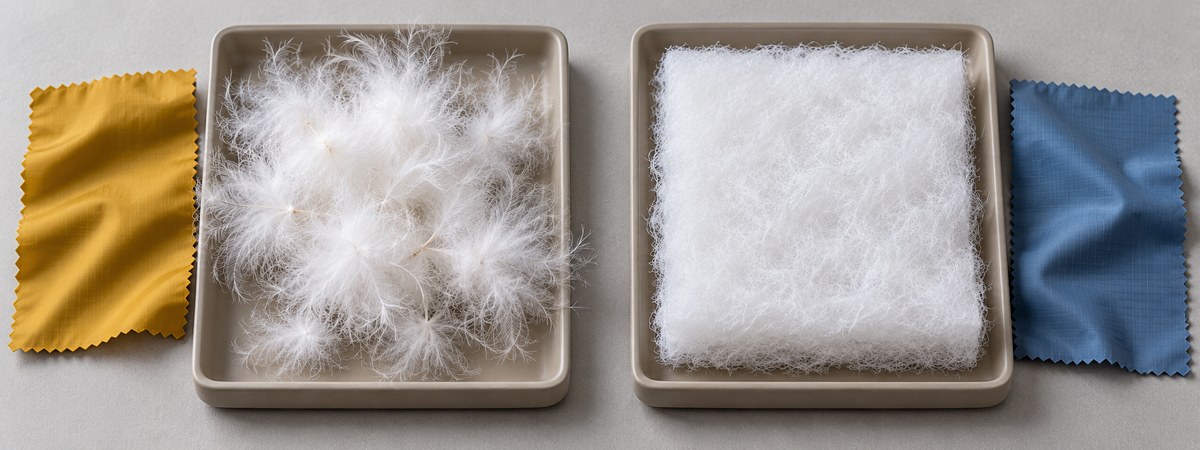
Patagonia’s insulation comparison identifies damp-weather performance as an important reason to choose synthetic insulation. PrimaLoft also describes its synthetic technology in relation to warmth when wet. Use those sources to frame material questions, not to promise identical performance from every filling.
Down can lose loft when wetted, while many synthetic options retain useful insulation more readily in damp conditions. The extent depends on the material, garment and exposure. Water-repellent treatments on down or shell fabric do not automatically make the complete jacket waterproof.
Discuss the shell, seams and intended layering system separately. Where the collection needs a dedicated rain barrier, compare the hardshell jacket product range. Keep moisture resistance, drying behaviour and whole-garment rain protection as distinct claims with their own supporting evidence.
Control Baffles, Quilting and Fill Distribution
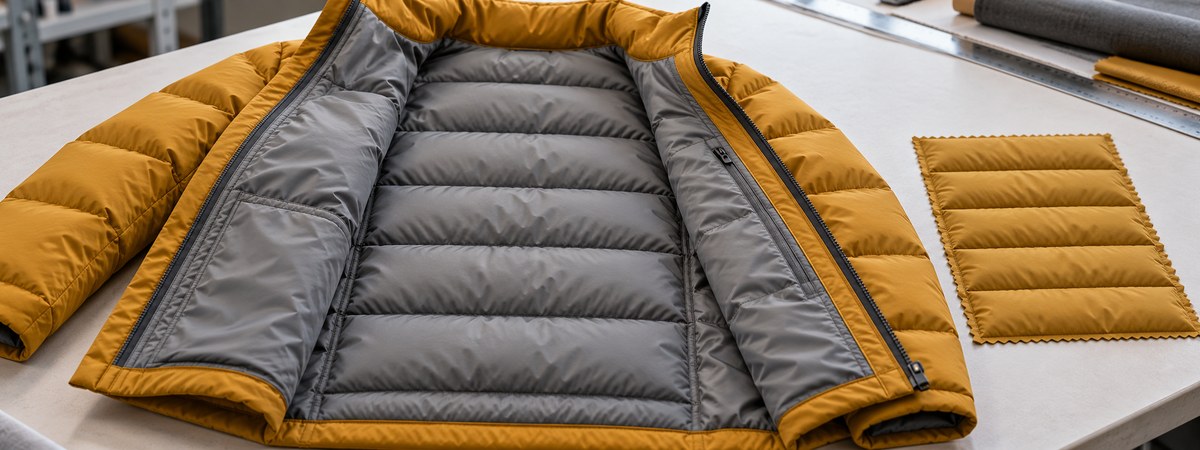
For down, define chamber layout, intended loft and filling allocation rather than approving only a quilted appearance. Sewn-through construction joins the outer and inner layers along stitch lines; box-wall constructions use internal separators. Their implications for bulk, assembly and heat loss need review within the proposed design.
For synthetic insulation, use the stabilisation approach suited to its format and supplier guidance. A quilting pattern that works for one batting may not be appropriate for another material or a loose-fill alternative.
Inspect distribution, thin areas, seam intersections and the way filling behaves after the agreed care and handling sequence. Record the approved sample and construction references. If fill, shell or chamber dimensions change, revisit the affected checks before treating the next sample as equivalent.
Compare Filling and Construction Together
Bring the shell, lining, insulation and sourcing requirements into the same sample review.
Review Warmth-to-Weight and Packing Recovery
Agree how garment mass will be measured: sample size, complete trim configuration and whether a storage pouch is included. Review the actual approved material package, not a prototype missing final components. Keep the development target separate from measured results.
Define a repeatable packing procedure and storage compartment, then assess unpacking and loft recovery under agreed conditions. Avoid assigning a universal recovery time without evidence. Packed dimensions and total weight describe different aspects of portability.
Do not turn a material comparison into an unsupported temperature promise. Activity, layers, wind, moisture and individual response affect comfort. Where a thermal claim is required, agree a suitable evaluation with the testing provider and document its conditions and scope.
Check Responsible Down Claims Through the Supply Chain
The Responsible Down Standard addresses animal-welfare requirements and traceability through a certification system. It is not a warmth grade. Textile Exchange explains that chain of custody tracks certified material through the supply chain, and product labelling depends on meeting the applicable requirements.
Request current certification information relevant to the entities and activities in your order, and confirm the transaction documentation needed for the shipment. A mill brochure or a certificate from an unrelated supplier does not establish that your finished product qualifies for a claim.
Check current rules and claim approval before printing an RDS logo or statement. For recycled synthetic insulation, separately verify composition and the evidence supporting the specific recycled claim. Neither responsible sourcing nor recycled content alone establishes a complete environmental ranking between two jackets.
Match Shell, Lining, Fit and Care to the Filling
Review shell and lining compatibility with the selected filling, including leakage or migration where relevant. IDFL lists downproofness among jacket testing considerations. Inspect the actual fabric and seams rather than assume a dense-looking textile will control filling adequately.
Fit the jacket over the intended layers and assess forward reach, shoulder movement, cuff coverage and collar comfort. Excess compression can reduce the space available for insulation; uncontrolled extra volume may create other fit and sealing issues. Check the intended sample setup consistently.
Agree care instructions for the complete garment, including filling, face finish, tape or bonding, trims and decoration. Drying requirements may differ between products. Validate the proposed instructions and review appearance, filling distribution and relevant performance after the agreed sequence.

Quote Cost and MOQ Against the Same Specification
Down cost depends on its specified quality, composition, sourcing requirements and amount, alongside the shell, lining and construction. Synthetic cost depends on the selected grade, format, quantity and assembly. Avoid treating either category as universally cheaper.
MontForge’s current down-jacket page lists MOQ starting from 100 pieces per colour and style. Confirm the applicable quantity for the proposed programme, plus any separate material, dyeing, trim or certification requirements. Small garment quantities do not automatically make every custom component available.
Ask the down jacket manufacturing team to quote the same size range, feature package and approval scope for each option. Browse the custom down jackets to discuss silhouettes, then request actual material availability, sampling stages, price and delivery timing against the current brief.
Send a Brief That Connects Materials to Bulk Approval
Include technical flats, intended use, size range, quantities by colour, target price and required dates. Identify which decisions are confirmed and which require supplier proposals. The outerwear tech pack guide provides a document-control framework; insulation-specific fields need their own detail.
| Brief field | What the supplier should confirm |
|---|---|
| Down option | Fill reference, composition, fill power method and weight allocation |
| Synthetic option | Supplier grade, format, composition and distribution |
| Construction | Chambers or quilting, shell, lining and trim references |
| Evidence | Agreed testing, post-care checks and sourcing documentation |
| Production release | Approved fit, material package, claims, care and inspection plan |
Link the final sample and approved documentation to the garment production process. Confirm MontForge’s project-specific capabilities and sourcing scope before making branded-material or certification promises in the collection.
Frequently Asked Questions
Does higher fill power mean a warmer jacket?
Not by itself. Consider fill amount, construction, coverage, fit and the conditions of the comparison.
Is synthetic insulation waterproof?
No. Damp-performance characteristics of filling do not establish waterproofness of the complete jacket.
Is RDS a performance certification?
No. It concerns responsible down sourcing requirements and traceability, not the jacket’s thermal rating.
Is synthetic always less expensive?
No. Compare the exact material grade, amount, construction and order requirements.
Can a brand use a supplier’s certification logo immediately?
Confirm the applicable certification chain, order documentation and claim or logo requirements first.
What MOQ should I plan around?
The published starting reference is 100 pieces per colour and style; confirm project terms and separate component minimums.
Ready to Develop Your Insulated Jacket?
Send your technical brief, fill preferences, colour quantities and required dates for a project-specific sampling and quotation discussion.
Sources
- IDFL: fill power questions and answers and jacket testing information.
- Textile Exchange: Responsible Down Standard and supply-chain certification.
- Patagonia: down and synthetic insulation comparison.
- PrimaLoft: synthetic insulation technology overview.
- MontForge: down jacket development and MOQ references.
Sources checked 31 October 2026. Verify current material guidance, certification rules and project terms before finalising claims.