The Ultimate Guide to Manufacturing Custom Merch T-shirts for Influencers & Brands (Part 1): Strategy, Design & Printing | Montforge
Introduction
In the dynamic landscape of digital content creation, influencers and brands are constantly seeking innovative ways to deepen audience engagement and monetize their platforms. Custom merchandise, particularly T-shirts, has emerged as a powerful tool, transforming followers into loyal advocates and generating significant revenue streams. With over 15 years of experience manufacturing custom apparel for brands across the UK, EU, and US markets, we have helped launch hundreds of successful merchandise lines. Written by Manus AI | Last updated: May 18, 2026. According to industry reports, the influencer marketing industry is projected to surpass $32 billion in 2026 [1], with custom apparel playing a crucial role in this growth. Estimated reading time: 11 minutes. However, navigating the complexities of manufacturing, from design to delivery, can be daunting.
This comprehensive guide, the first in a two-part series, will walk you through the essential steps of understanding the market, strategically positioning your custom merch, choosing the right printing techniques, and preparing your designs for custom merch t-shirt products for influencers and brands. By the end of this article, you will be equipped with the knowledge to confidently plan and design your merchandise line, turning your creative vision into a tangible product. For insights into manufacturing, cost, and fulfillment, see Part 2: Manufacturing, Costs & Logistics.
Understanding the Influencer Merch T-shirt Market
The custom merch market offers a significant opportunity for influencers and brands to connect with their audience and build a sustainable revenue stream.
Why Influencers and Brands Are Investing in Custom Merch
Custom merchandise serves as a powerful extension of an influencer's or brand's identity, fostering a deeper connection with their audience. It transforms passive viewers into active participants, allowing them to physically represent their support. For influencers, merch provides a direct monetization channel, diversifying income beyond ad revenue and sponsorships. For brands, it enhances brand loyalty, creates walking advertisements, and offers a unique way to engage with consumers. For example, successful cases like Logan Paul's Prime Hydration have demonstrated the immense potential of influencer-backed products, leveraging a dedicated fanbase to achieve rapid market penetration and significant sales.
The Economics of Custom Merch T-shirts
Understanding the cost structure and potential ROI is crucial for a successful merch line. The unit cost of a custom T-shirt is influenced by factors such as fabric quality, printing method, design complexity, and order volume. Pricing strategies should consider production costs, perceived value, target audience, and competitor pricing. A well-executed merch line can yield substantial profit margins, especially when scaled efficiently. Calculating ROI involves assessing initial investment against projected sales and brand exposure.
Who Should Start a Merch Line
The decision to launch a merch line depends on several factors, including audience size, engagement levels, and brand maturity. While mega-influencers with millions of followers (100,000+ followers) can leverage their vast reach for large-scale production and diverse product offerings, micro-influencers (10,000-100,000 followers) can benefit from lower MOQ options and niche-specific designs, fostering a strong sense of community. Growing brands can use merch to solidify their identity and expand their market presence. The key is to align your merch strategy with your audience's demographics and your brand's overall objectives.
Choosing the Right Printing Method
For influencers and brands, choosing the right printing method for your merch is a strategic decision that impacts quality, cost, and overall brand perception.
Selecting the optimal printing method is critical for achieving desired quality, durability, and cost-effectiveness for your custom merch T-shirts.
Screen Printing – The Industry Standard
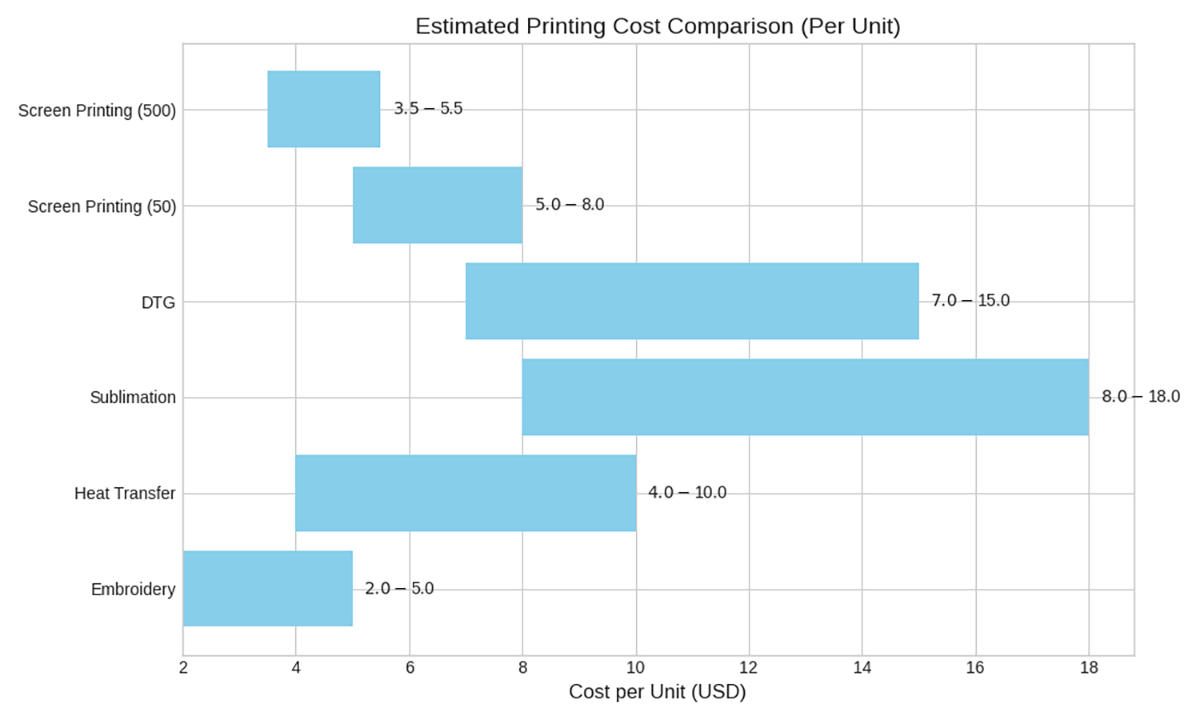
Screen printing involves pushing ink through a woven mesh stencil onto fabric. It's renowned for its vibrant colors, excellent durability, and cost-efficiency for large orders. However, it typically has color limitations (usually 4-6 colors per design) and requires a minimum order quantity (MOQ) due to setup costs. It's best suited for designs with solid colors and fewer gradients, making it a popular choice for high-volume, classic merch. For example, a run of 500 T-shirts might cost $3.5 - $5.5 per unit, while 50 units could be $5 - $8 per unit.
Direct-to-Garment (DTG) Printing – Freedom of Detail
DTG printing functions much like an inkjet printer, directly applying ink onto the fabric. This method offers unlimited color options and photo-realistic detail, with no minimum order quantity, making it ideal for intricate designs and smaller runs. However, DTG typically has a higher per-unit cost than screen printing and works best on 100% cotton garments. It's perfect for testing new designs or offering personalized items. The cost for a single DTG printed T-shirt might be $7 - $15.
Sublimation Printing – All-Over Freedom
Sublimation printing uses heat to transfer dye onto fabric, resulting in a vibrant, permanent, and all-over print that won't crack or fade. This method is excellent for complex, full-coverage designs and offers superior breathability. Its main limitation is that it's primarily suitable for polyester fabrics. Sublimation is often used for athletic wear and specialized apparel where dynamic, edge-to-edge designs are desired. A sublimated T-shirt might cost $8 - $18 per unit.
Heat Transfer & Embroidery – Special Effects
Heat transfer involves applying a design printed on special paper onto fabric using heat and pressure. It's versatile for various materials and offers good color reproduction, though durability can vary. Embroidery, on the other hand, uses thread to stitch designs directly onto garments, providing a premium, textured, and highly durable finish. Both methods are excellent for adding special effects, logos, or branding elements. Embroidery typically has a higher cost and MOQ compared to heat transfer, with a basic embroidered logo costing around $2 - $5 (for a basic logo).
How to Choose the Right Printing Method for Your Merch
Choosing the right printing method depends on your specific needs. Consider your order volume, design complexity, fabric choice, and budget. For large orders with simple designs, screen printing is cost-effective. For intricate, multi-color designs or small batches, DTG is ideal. Sublimation is best for all-over prints on polyester. Heat transfer and embroidery add unique textures and premium finishes. Below is a decision matrix to help you choose:
Printing Method | Best For | Pros | Cons | Cost (per unit, estimated) | MOQ (estimated) |
|---|---|---|---|---|---|
Screen Printing | Large orders, simple designs | Durable, vibrant colors, cost-effective for bulk | Limited colors, high MOQ | $3 - $8 | 50-100 pieces [4] |
Direct-to-Garment (DTG) | Small orders, complex designs, photo-realistic | Unlimited colors, no MOQ, high detail | Higher unit cost, best on cotton | $7 - $15 | No MOQ |
Sublimation Printing | All-over prints, athletic wear | Vibrant, durable, breathable, full coverage | Limited to polyester fabrics | $8 - $18 | 100-200 pieces |
Heat Transfer | Versatile, special effects | Good color, works on various fabrics | Durability varies | $4 - $10 | Low |
Embroidery | Premium look, durability | High-quality, textured, very durable | Higher cost, design limitations | $2 - $5 (for a basic logo) | 50-100 pieces |
Design and File Preparation Guide
Precise design and file preparation are essential to ensure your custom merch T-shirts are produced exactly as envisioned.
Understanding Design File Requirements
Proper file preparation is crucial for high-quality printing. Pay close attention to color modes (CMYK for print, Pantone for specific brand colors, rather than RGB), resolution (typically 300 DPI for print), and dimensions. Ensure your designs include appropriate bleed areas and safe zones to prevent critical elements from being cut off. Common file formats include AI, EPS, PSD, and high-resolution PDFs, each with specific advantages for different design types. Montforge can assist with these technical specifications to ensure optimal print results.
Design Tips for Different Printing Methods
Design considerations vary by printing method. For screen printing, opt for designs with fewer colors and clear separations. For DTG printing, you have more freedom with gradients and photographic details. Sublimation printing allows for all-over, seamless designs. Understanding these nuances will help you optimize your artwork for the chosen production technique.
Working with Designers or Design Services
You can either use an in-house designer or outsource your design needs. Outsourcing offers access to specialized skills and can be cost-effective for one-off projects. Platforms like Figma and Adobe Creative Suite are industry standards for design creation. When working with external designers, clearly communicate your vision, brand guidelines, and technical specifications. The cost of design services can range from $50 - $150 for a simple logo to $200 - $500+ for a complex graphic.
RFQ Focus: Creative, Design & Printing Strategy
When initiating an RFQ (Request for Quotation) for the creative and design phase of your merch line, please provide the following information to ensure the most accurate consultation:
• Target Audience & Brand Vision: Describe your audience demographics and the core message of your brand.
• Design Files & Technical Specs: Attach your final artwork (AI, EPS, PSD, or high-res PDF) and specify color codes (Pantone), print size, and placement.
• Preferred Printing Method: Indicate if you have a preference (e.g., Screen Printing, DTG, Sublimation) or need our recommendation based on your design.
• Garment & Material Choice: Specify the T-shirt type (e.g., 100% cotton, polyester blend), desired weight, and color.
• Initial Sampling Needs: Outline your requirements for pre-production samples and physical prototypes for approval.
About the Author:
Written by Montforge Production Team | Last updated: May 06, 2026
[Insert: Author Bio/Contact Information for Montforge]