Outdoor & Tactical Shorts: Pockets, Reinforcement and Durability
Outdoor and tactical shorts are bought for three things: carrying gear, surviving abuse, and staying wearable in heat or wet conditions. That makes them a construction problem as much as a fabric problem — a pocket layout that distributes load without bouncing, reinforcement at every stress point, and a ripstop shell chosen for the right environment. This guide covers the pocket architecture, the reinforcement checklist, nylon versus poly-cotton ripstop, hiking and fishing requirements, and the colour and trim options that finish a programme.
Multi-Pocket Utility Layout
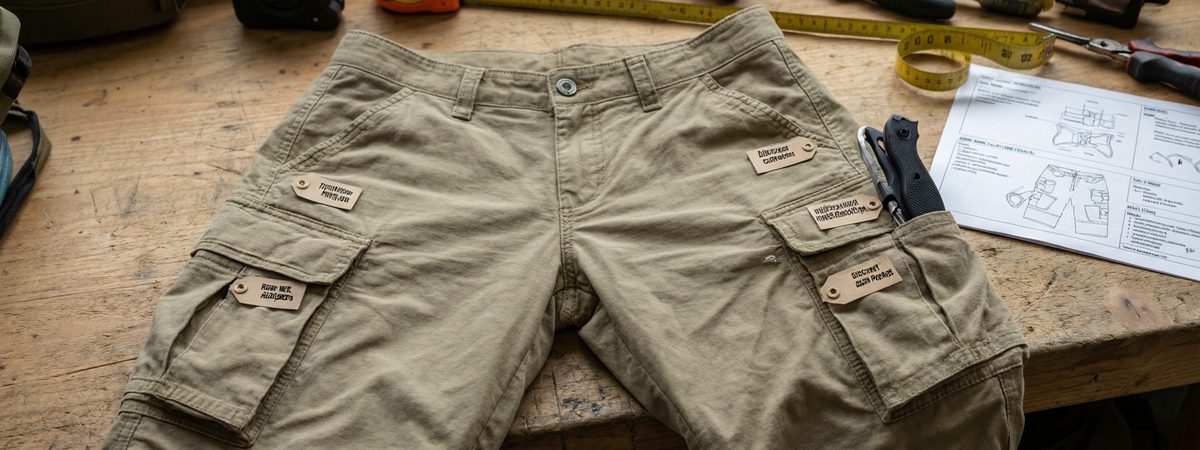
A utility short lives or dies by its pocket architecture, and the best layouts follow a load logic rather than adding pockets for the spec sheet. A proven configuration runs: two slash hand pockets deep enough for a phone (around 11 inches on a tactical cut) with a reinforced inner section to clip a knife; two bellow cargo pockets on the thigh with flap closures; a dedicated knife or multitool pocket; two rear pockets positioned above the sit bones for comfort when sitting on rocks or in a vehicle; and a small hidden pocket at the rear waistband for a spare key or cash. Add zippered or hook-and-loop closures to every cargo and rear pocket — an open pocket on a trail will eventually empty itself — and keep the phone and tool pockets on the sides of the thigh rather than the front, where they interfere with stride and dig in when you sit.
Reinforced Seam Construction
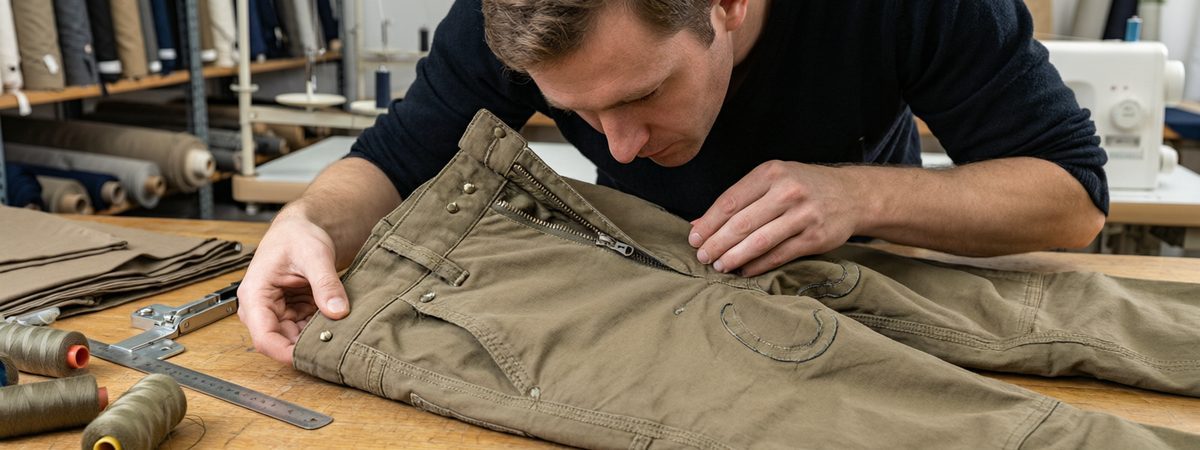
Durability in a utility short is won at the seams, not in the fibre alone. The reinforcement checklist starts with bar tacks at every stress point: pocket corners, the top and bottom of pocket openings, belt loops, the waistband closure and the crotch seam. Major seams should be double-needle at minimum, with triple-needle stitching on the seat and side seams of a heavy-duty tactical cut, sewn with a heavy nylon thread (T40 is a common spec) rather than a standard gauge. A horseshoe or diamond gusset panel at the crotch adds mobility and removes the single highest-failure seam in any short; a double seat or diamond reinforcement protects the highest-abrasion zone. Finish with YKK zips on every closure, and specify seam allowances generous enough that a repair is possible. When you evaluate a supplier, the hardware and the bar tacks are a more reliable durability signal than the word "ripstop" on the label.
Nylon vs Poly-Cotton Ripstop
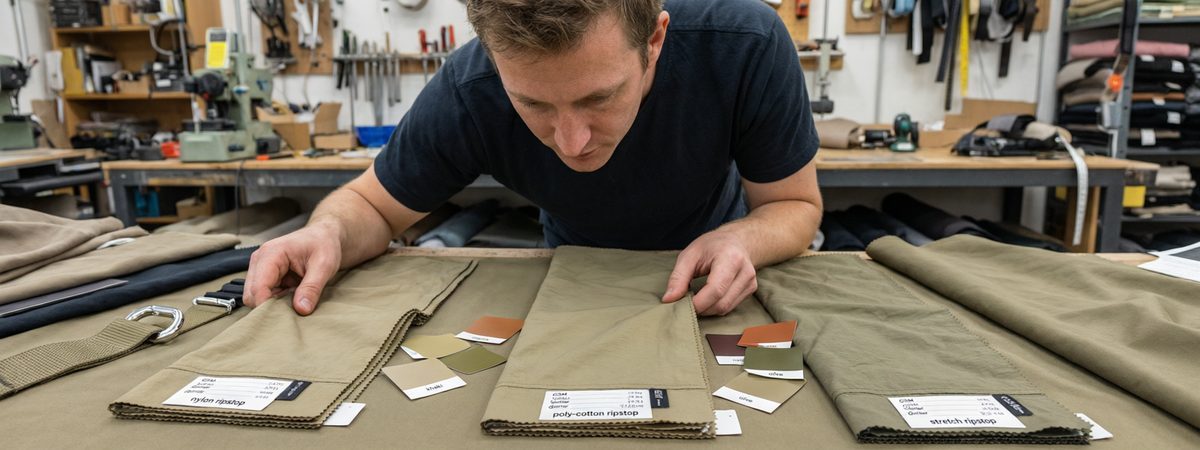
The ripstop weave — thicker reinforcement threads woven into a grid so a tear stops at the nearest cell — is common to both, and the fibre choice changes everything else. Nylon ripstop is the strongest option per gram, naturally hydrophobic and slightly elastic, available from around 20 denier for ultralight shells up to 200 denier for tactical outerwear; it dries fast and packs small, but it feels slick, runs loud, is less breathable than cotton and degrades faster under prolonged UV. Polyester ripstop is stiffer with no natural stretch, yet it resists UV degradation better and costs less, which is why it dominates budget outdoor programmes. Between them sits the blend that most tactical programmes actually specify: NYCO (a 50/50 nylon-cotton weave) or the more common poly-cotton ripstop at roughly 65% polyester to 35% cotton, where the polyester brings abrasion resistance and faster drying while the cotton brings breathability, quietness and a natural hand. A cotton-rich 70/30 skews softer and more breathable for hot climates, and adding 2–3% spandex turns any of them into a stretch version that moves with the wearer. We go deeper on the construction mechanics in our guide to nylon ripstop and grid-weave fabrics.
Choosing GSM and Finish for the Environment
Weight and finish decide whether the short is usable in the field. As a working range: cotton-rich blends at roughly 180–220 gsm with a DWR or Teflon-type finish suit hot, humid conditions and everyday wear; nylon-rich blends at 150–200 gsm with a full-garment DWR and a UPF rating suit cooler or wetter programmes where drying speed matters. Below about 120 gsm, a short marketed as tactical is a thin-fabric red flag. Two clarifications worth giving buyers: ripstop itself is not waterproof — the grid only provides tear resistance, so water repellency comes from a DWR finish for light rain or a PU laminate for true waterproofing at the cost of breathability — and UPF protection is built into the weave rather than applied as a coating, so a UPF 50+ rating blocks over 98% of UV and does not wash out. For fishing and water-adjacent use, a lighter nylon or polyester shell with strong UPF and quick-dry behaviour beats a heavier cotton-rich blend every time.
Hiking and Fishing Use Cases
Hikers and anglers want different things from the same garment, and the brief should say which is primary. A hiking short prioritises four-way stretch (4–8% spandex), moisture management, a gusseted crotch for scrambling, and a waistband that will not roll under a pack belt. A fishing short prioritises low water absorption, fast drying, and strong UV protection because reflected light off water raises exposure, plus secure pockets that will not spill when you lean over a gunwale. Where hunting or wildlife observation is the use case, quietness becomes a specification: poly-cotton ripstop or a brushed, peached finish runs far quieter than 100% nylon, which has a noticeable rustle. Build the pocket layout around the activity — two to three pockets is enough for a day hike, four or more for all-day or multi-day carry — and keep the waistband elastic or drawcord-adjustable so the fit can change as layers and gear come on and off.
Custom Colour and Trim
Colour and hardware are where a programme becomes a brand. The core outdoor and tactical palette — khaki, coyote, olive, ranger green, stone and black — is the practical starting point, with camo prints and custom colourways available through sublimation or piece dyeing depending on the base fabric. Hardware choices matter as much as colour: a no-twist D-ring for keys or a carabiner, wide belt loops (around 2.4 inches) that accept an EDC, utility or Cobra belt, hook-and-loop or slotted-button closures that will not fail under load, and YKK zips throughout. Branding on a utility short usually sits as a small embroidered or heat-transfer logo on the cargo pocket flap, the left thigh or the rear waistband, with woven labels inside the waistband and a woven or printed size tab. Specify all of it against the fabric — embroidery needs a stable panel, and reflective or high-vis trim should be integrated into a seam rather than applied as an edge that can lift.
Sampling a Utility Short
A utility short has more build points than a simple training short, so the sample stage earns its keep. Order one sample in the final fabric and put it through real use: load every pocket to capacity and check that the waistband and belt loops hold, sit and squat to test the gusset and seat reinforcement, and wash it twice to confirm shrinkage, colour retention and DWR behaviour. Confirm on the sample that the bar tacks are present at every stress point, that the cargo flaps close securely, and that the hardware matches the spec sheet. For programmes that involve camo or custom dyeing, approve a lab dip first — colour consistency across a multi-size run is the most common field complaint on utility apparel.
Low MOQ and Programme Scaling
Utility shorts suit low-MOQ programmes well because the construction is repeatable: once the pattern, pocket layout and hardware pack are approved, a 50–100 piece run is straightforward and larger runs mostly change the unit price rather than the product. That makes the category accessible for what it usually serves — outfitters, guide services, clubs, security and fieldwork teams, and small outdoor brands testing a design before a broader launch. The practical approach: lock the fabric spec and the trim pack once, archive the tech pack with the pocket layout and hardware codes, and reorder against it so every subsequent run matches the first. If you plan to extend the range, the same pattern block usually carries into a cargo pant, which makes the initial development cost go further.
MontForge Outdoor and Tactical Short Capabilities
MontForge manufactures custom outdoor and tactical shorts for performance, training and fieldwork brands. We build nylon ripstop, polyester ripstop, NYCO and poly-cotton ripstop shells from roughly 120 to 220 gsm, with spandex stretch options, DWR and Teflon-type finishes, and UPF-rated constructions. Construction is specified rather than assumed: bar tacks at every stress point, double and triple-needle seams, horseshoe or diamond gussets, double seat reinforcement, heavy nylon thread, YKK zips and a full hardware pack including D-rings, webbing loops and wide belt loops sized for EDC belts. Pocket layouts are built to your brief — bellow cargo, tool, phone, rear and hidden waistband pockets — and branding runs across embroidery, heat transfer, woven labels and custom camo or colourwork. Low MOQ, a short sample window and archived tech packs make repeat runs straightforward.
Frequently Asked Questions
How many pockets should a tactical short have?
Two to three pockets are enough for a day hike; four or more suits all-day or multi-day carry. A practical layout: deep slash hand pockets with a knife clip section, bellow cargo pockets with secure flaps, a tool pocket, rear pockets above the sit bones, and a small hidden waistband pocket.
Where does a utility short need reinforcement?
Bar tacks at pocket corners and openings, belt loops, the waistband closure and the crotch seam; double-needle on major seams and triple-needle on the seat and side seams; a gusset panel at the crotch; and a double or diamond-reinforced seat. Hardware and bar tacks are the most reliable durability signal.
Nylon or poly-cotton ripstop?
Nylon ripstop is the strongest per gram, dries fast and packs small, but is louder, less breathable and less UV-stable. Poly-cotton ripstop at around 65/35 brings abrasion resistance with breathability and quietness. NYCO at 50/50 is the tactical standard. Pick by climate and by whether stealth matters.
Is ripstop waterproof?
No. Ripstop only provides tear resistance — the weave still has gaps. Water repellency comes from a DWR finish, which handles light rain and splashes but saturates in sustained downpour. True waterproofing needs a PU or laminate coating, which reduces breathability.
What fabric weight suits hot and wet climates?
For hot, humid conditions use a cotton-rich ripstop at roughly 180–220 gsm with a DWR or Teflon-type finish and four-way stretch. For cooler or wet programmes use a nylon-rich shell at about 150–200 gsm with full-garment DWR and a UPF rating. Below about 120 gsm is a red flag.
Ready to build a utility short programme? Send us your pocket layout and fabric spec or browse MontForge custom shorts — ripstop shells, reinforced construction and full trim packs at low MOQ.