How to Choose a Reliable T-shirt Manufacturer (2026 Guide for Brands)
Quick Answer: How to Choose a Reliable T-shirt Manufacturer?
To choose a reliable T-shirt manufacturer, define the garment, quantity, quality requirements and work you expect the supplier to manage. Compare relevant samples, material sourcing, development, production controls and commercial terms. A strong proposal makes assumptions visible and provides a clear route from the first sample to an approved bulk order.
Why Finding a Reliable T-shirt Manufacturer is Critical for Your Brand
Choosing a T-shirt manufacturer means deciding who will turn the product brief into repeatable goods. The useful comparison covers the garment, order structure, sampling, communication and delivery responsibilities. A familiar customer name can inform the shortlist, but the new order needs its own evidence.
The Cost of a Poor Manufacturing Partner
A low initial quote can become expensive if it excludes necessary development or uses the wrong material. Delays, incorrect labels, failed decoration and poor dimensional stability affect different parts of the business. Identify the product failures that matter most before comparing suppliers so those requirements stay visible in the sample review.
Navigating Your Manufacturing Journey: A Guide for Every Brand
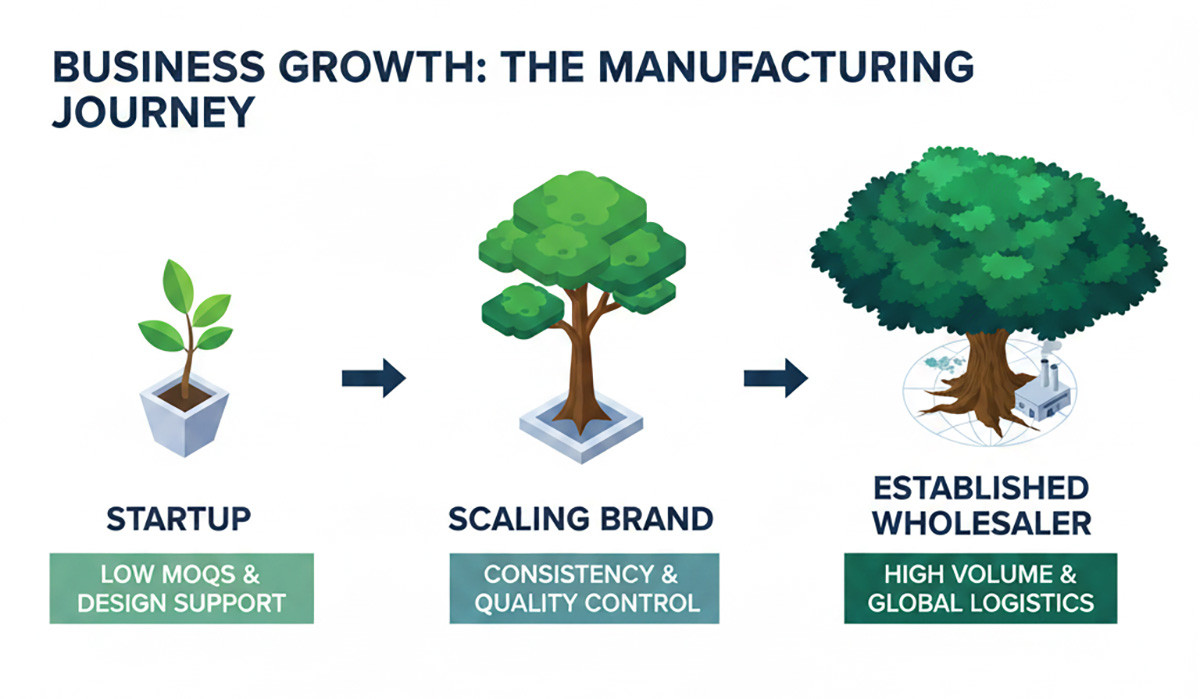
A startup, a scaling brand and a wholesaler can need different levels of development support and product control. State the current task before evaluating a supplier:
• Startup: establish the garment, design handoff and a manageable initial stock commitment.
• Scaling brand: reproduce the approved product and define capacity, reorder materials and change control.
• Wholesaler: confirm assortment, repeat supply, packing and receiving requirements across the order.
Use the brand stage to prioritise questions, while keeping the same evidence standard for the garment.
4 Key Types of T-shirt Manufacturers: Understanding Your Options
Service labels help begin the discussion but often overlap. Confirm who provides the design, materials, patterns, samples and approvals in the written scope.
OEM vs. ODM vs. CMT vs. Full-Package (FPP)
| Manufacturer Type | Description | Advantages | Ideal Scenarios |
|---|---|---|---|
| OEM (Original Equipment Manufacturer) | Produces garments based on client-provided designs, tech packs, and materials. | Full control over design, high product uniqueness, strong scalability for established designs. | Brands with in-house design teams seeking unique, custom-designed products. |
| ODM (Original Design Manufacturer) | Offers in-house designs that clients can select and customize to fit their brand identity. | Faster production cycles, lower initial development costs, ideal for quick market entry or product testing. | Startups with limited design resources, or retailers looking to quickly launch new product lines. |
| CMT (Cut, Make, Trim) | Provides basic production services: cutting, sewing, and trimming. All materials and designs are supplied by the client. | Complete control over material sourcing and design specifics, often more cost-effective for brands with existing supply chains. | Brands with established designs, in-house development teams, and direct material sourcing capabilities. |
| Full-package service | Coordinates the agreed development, sourcing and manufacture | Fewer contacts where responsibilities are defined; coordination still needs checking | Buyers wanting identified tasks managed under one commercial scope |
Use the scope to compare proposals. OEM does not automatically include all material sourcing; ODM does not automatically license every design right; a full-package offer still needs clear ownership, approvals and delivery responsibilities.
Sourcing Locations to Investigate
Use location to plan enquiries and the production route. Then evaluate the actual site, product experience, material access and commercial offer. The following questions avoid treating country reputation as a supplier audit.
1. China: The Global Manufacturing Hub
For a Chinese candidate, identify relevant T-shirts, the nominated fabric route and any specialist decoration. Confirm where each operation happens and how an approved material or pattern can be repeated.
2. Vietnam: A Rising Star in Apparel Production
For a Vietnamese candidate, check material sourcing, garment-development scope and the actual shipping route. Verify any proposed preferential treatment using the product, origin and destination rules; no general US trade-agreement advantage is assumed.
3. Pakistan: Cost-Effective with Rich Textile Heritage
For a Pakistani candidate, assess the exact cotton or blended garment, material references, decoration and production arrangement. Compare the sample and delivered quote with the same specification used elsewhere.
4. India: Diverse Capabilities and Cotton Expertise
For an Indian candidate, confirm which knitting or weaving, processing, sewing and decoration stages are included. Match the supplier's product references to the requested construction and planned quantity.
5. Turkey: Proximity to Europe and Quality Focus
For a Turkish candidate, assess the potential transport and development benefits for the destination using a current quote. Confirm the actual manufacturing site, material origin and scope of any compliance evidence.
| Country enquiry | Product question | Supply-route question | Commercial question |
| China | Comparable garment and decoration? | Named fabric and assembly sources? | Complete quote for the intended mix? |
| Vietnam | Relevant fit and construction sample? | Material readiness and actual origin? | Applicable shipment terms and charges? |
| Pakistan | Identified fabric and print trial? | Which operations are included? | Minimums and development fees? |
| India | Relevant garment and material sample? | Which stages are subcontracted? | Revision and bulk-release conditions? |
| Turkey | Suitable garment and size range? | Actual route to destination? | Delivered cost and receiving date? |
Shortlist a route when it can support the garment and commercial conditions you need. Apply document, sample and production checks to the named supplier.
Understanding the Cost Breakdown of Custom T-shirt Manufacturing
One of the most critical aspects when considering how to choose a clothing manufacturer is understanding the cost structure. The price of a custom T-shirt is not just a single figure; it's a composite of several factors. A reliable T-shirt manufacturer will provide a transparent breakdown, helping you manage your budget effectively and avoid unexpected expenses.
Key Factors Influencing T-shirt Manufacturing Costs:
1 Fabric Type and Quality: This is often the largest cost component. Premium fabrics (e.g., organic cotton, specialized performance blends) will be more expensive than basic cotton. The fabric's weight (GSM - grams per square meter) also plays a role, with heavier fabrics generally costing more.
2 Design Complexity: Intricate designs, multiple print locations, complex patterns, or specialized embellishments (e.g., embroidery, appliqué) require more labor and specialized machinery, increasing costs.
3 Printing/Decoration Method: Different decoration techniques have varying costs. Screen printing is cost-effective for large runs with fewer colors, while Direct-to-Garment (DTG) is better for complex, multi-color designs on smaller quantities. Embroidery and sublimation also have distinct pricing structures.
4 Minimum Order Quantity (MOQ): Generally, the higher the MOQ, the lower the per-unit cost. Manufacturers offer economies of scale, so producing in bulk reduces the cost of setup, materials, and labor per item.
5 Order Volume: Beyond MOQ, the overall volume of your order impacts pricing. Larger orders often qualify for better discounts.
6 Customization Details: Elements like custom neck labels, hang tags, special packaging, or unique finishing treatments (e.g., garment dyeing, distressing) add to the overall cost.
7 Lead Time: Rush orders or expedited production will typically incur additional fees due to overtime labor or expedited material sourcing.
8 Shipping and Logistics: For international orders, shipping method (air vs. sea freight), destination, and customs duties significantly affect the final landed cost. Always clarify Incoterms (International Commercial Terms) with your manufacturer.
| Cost Factor | Impact on Price | Notes |
|---|---|---|
| Fabric | High | Type (organic, blend), weight (GSM), origin. |
| Design | Medium to High | Complexity, number of colors, print locations. |
| Decoration | Medium to High | Screen print, DTG, embroidery, sublimation. |
| MOQ/Volume | Inverse (higher volume, lower unit cost) | Economies of scale. |
| Customization | Medium | Labels, tags, packaging, special finishes. |
| Lead Time | Medium (rush fees) | Expedited production. |
| Shipping | Medium to High | Air vs. sea, destination, customs. |
By understanding these cost drivers, you can have more informed discussions with potential manufacturers and better evaluate their quotes. A reliable T-shirt manufacturer will help you optimize these factors to meet your budget without compromising quality.
Use one supplier worksheet, then let the sample challenge it
MontForge's successful collaboration with Montirex is part of its manufacturing background. For a new T-shirt buyer, that relationship is relevant context, but the choice of supplier still has to connect to the actual garment being developed. A named customer does not remove the need for a clear brief and a comparable sample.
The practical comparison is between suppliers' responses to the same task. Ask each to quote the same fabric direction, measurements, colour mix, artwork and packing. Separate proposed alternatives from the base offer.
| Supplier response | What it reveals | Follow-up before commitment |
|---|---|---|
| Explains an unsuitable fabric or decoration combination | Whether the supplier has considered the product rather than only the price | Request a trial of the proposed alternative |
| Identifies an incomplete measurement or artwork requirement | Whether the quote rests on unresolved assumptions | Complete the brief and update the price |
| Documents a sample correction | Whether a problem becomes a controlled revision | Check that the new sample and files agree |
| Changes a material without recording it | A gap in change control | Resolve the substitution and approval process |
Distinguish an attractive sample from a reproducible garment
A presentation sample may demonstrate appearance while leaving bulk materials or size grading unresolved. Record what the sample actually represents. Ask whether the nominated fabric, trim and decoration process will be used in production.
Evaluate the critical features for the product: fabric behaviour, neckline recovery, seam construction, measurements and decoration after the agreed care trial. Use observations and measurements, not only a general quality score.
Make the comparison specific enough to disagree with
A statement such as “good communication” is difficult to act on. Record whether questions were answered, changes were documented and the next approval was clear. Similarly, “flexible MOQ” should become an actual order structure for the proposed style and colour mix.
Use the supplier's case history to decide what to investigate, then use the project evidence to decide whether to proceed. This keeps a commercial endorsement useful without turning it into a substitute for product qualification.
Send MontForge the same specification used for the shortlist, then compare the proposal with the sample and intended purchase order.
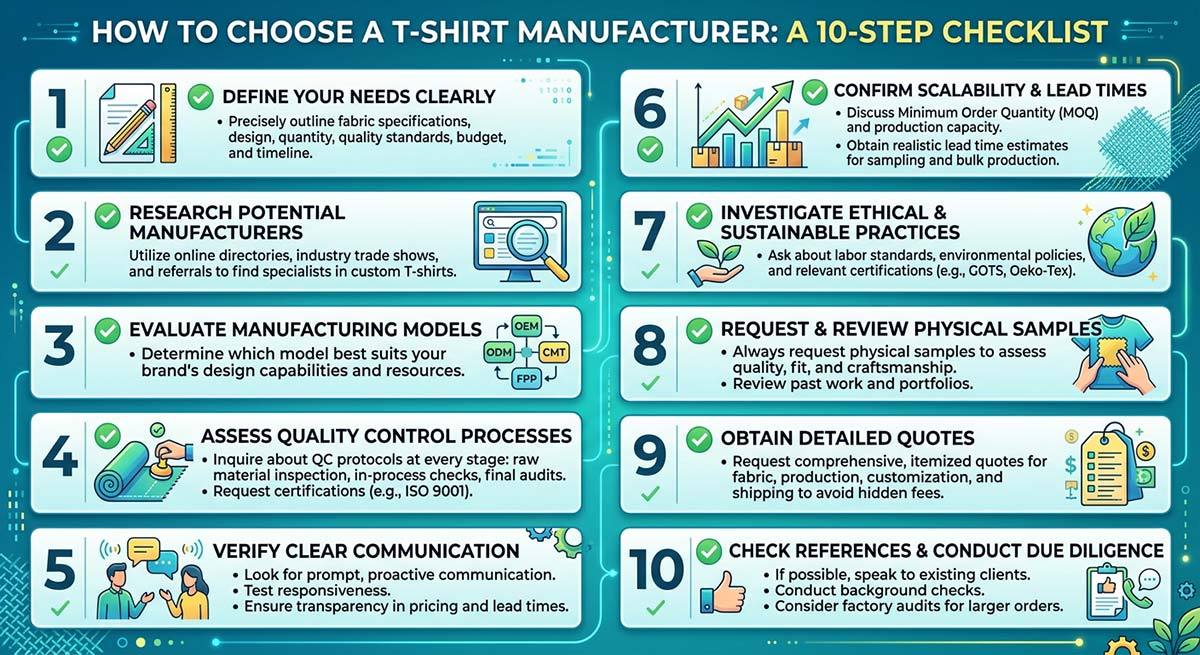
10-Step Checklist to Choose a Reliable T-shirt Manufacturer
Use the following ten steps to keep the supplier comparison tied to the same brief. Record findings and unresolved questions rather than assigning a score from website claims alone.
1. Define Your Needs Clearly: Before you begin your search, precisely outline your product specifications (fabric, design, quantity, quality standards), budget, and timeline. This clarity will streamline your search and communication.
2. Research Potential Manufacturers: Utilize online directories, industry trade shows, and referrals to identify manufacturers specializing in your product type (e.g., custom T-shirts, sportswear). Look for those with experience serving your target market (e.g., Europe, North America).
3. Evaluate Manufacturer Types (OEM, ODM, CMT, FPP): Determine which manufacturing model best suits your brand's design capabilities, control preferences, and resource availability. (Refer to the '4 Key Types' section above).
4. Assess Quality Control Processes: Inquire about their QC protocols at every stage: raw material inspection, in-process checks, and final product audits. Request certifications (e.g., ISO 9001) and ask for examples of their quality assurance documentation.
5. Verify Communication & Transparency: Look for manufacturers who offer clear, prompt, and proactive communication. Test their responsiveness during initial inquiries. Transparency in pricing, lead times, and problem-solving is non-negotiable.
6. Confirm Scalability & Lead Times: Discuss their Minimum Order Quantity (MOQ) and maximum production capacity. Obtain realistic lead time estimates for sampling and bulk production, and understand their flexibility for future growth.
7. Investigate Ethical & Sustainable Practices: Ask about their labor standards, environmental policies, and any relevant certifications (e.g., GOTS, Oeko-Tex, WRAP). A commitment to sustainability enhances your brand's reputation and reduces risk.
8. Request Samples & Review Portfolios: Always request physical samples to assess quality, fit, and craftsmanship firsthand. Review their past work and case studies, paying attention to brands similar to yours.
9. Obtain Detailed Quotes & Understand Cost Breakdown: Request comprehensive quotes that clearly itemize costs for fabric, production, customization, and shipping. Compare multiple quotes to ensure competitive pricing and avoid hidden fees.
10. Check References & Conduct Due Diligence: If possible, speak to their existing clients. Conduct background checks and, for larger orders, consider factory audits to verify their operational integrity and financial stability.
By diligently following these steps, you significantly increase your chances of finding a reliable T-shirt manufacturer that will be a true asset to your brand.
Red Flags to Watch Out For When Choosing a Clothing Manufacturer
While diligently searching for a reliable T-shirt manufacturer, it is equally crucial to recognize potential warning signs that could indicate future complications. Being aware of these red flags can save your brand significant time, money, and reputation. This section will help you identify what to avoid when you choose a clothing manufacturer.
•Lack of Transparency: A manufacturer unwilling to openly discuss their production processes, material sourcing, or pricing structures is a major red flag. Transparency builds trust; obfuscation often hides inefficiencies, quality compromises, or unethical practices. Be wary of vague answers or reluctance to provide detailed information.
•Poor Communication & Responsiveness: Slow, unclear, or inconsistent communication is a precursor to production delays and misunderstandings. A truly reliable T-shirt manufacturer prioritizes clear, timely, and proactive dialogue, especially when addressing concerns or providing updates. If initial interactions are difficult, expect greater challenges during production.
• Missing product evidence: request relevant samples and process records. Confidentiality may limit customer disclosures, so evaluate appropriate alternatives rather than treating the absence of a public case study as proof of inexperience.
• An unexplained low quote: reconcile material, construction, quantity and delivery assumptions. A price difference needs explanation before it supports a supplier decision.
•Disregard for Ethical & Sustainable Practices: In today's conscientious market, manufacturers who show little to no commitment to ethical labor or sustainable production are a significant risk. This not only exposes your brand to potential consumer backlash but also indicates a lack of foresight and modern industry standards. Look for certifications and a clear policy on social responsibility.
•Inflexible MOQs or Production Processes: While MOQs are standard, a manufacturer that is completely inflexible, especially for initial orders or during scaling, might not be the right long-term partner. Similarly, rigid production processes that cannot accommodate minor adjustments can hinder product development and innovation.
By staying vigilant and recognizing these warning signs, you can effectively mitigate risks and ensure you partner with a truly reliable T-shirt manufacturer.
Montforge: Your Reliable Partner in Apparel Manufacturing
MontForge and Montirex: a successful manufacturing collaboration
MontForge has worked successfully with Montirex. For a prospective buyer, this is relevant manufacturing experience to discuss alongside the sample and production plan for the next garment.
Keep relationship evidence separate from an order outcome. The collaboration does not establish a particular revenue increase, first-order date or manufacturing quantity without supporting project records.
For a MontForge enquiry, identify the T-shirt style, nominated or proposed fabric, fit direction, size mix, artwork and delivery destination. Ask for the development scope, sample charges, minimums and required approvals. Compare that proposal with the same brief used for other suppliers.
Preparing a T-Shirt Manufacturing Enquiry
A useful enquiry gives the supplier enough detail to identify what can be quoted and what needs development. State which product features are fixed and where you want alternatives.
What to Send MontForge
Include a sketch or reference, measurements, fabric direction, artwork, order mix and desired receiving date. Mark assumptions rather than leaving the supplier to infer them.
Next Steps for Product Development
• Product review: ask which specification details need to be resolved before a reliable quotation.
• Sample plan: agree the intended material, development questions, revision stages, charges and target dates.
• Commercial proposal: request the actual minimums, inclusions, exclusions and delivery responsibilities.
Prepare a Written Supplier Evaluation
Keep the evaluation record with the quotation and sample comments so the production decision can be traced to the evidence.
Frequently Asked Questions (FAQs) About Custom T-shirt Manufacturing
These questions cover product development, order structure and delivery for custom T-shirt buyers.
Q1: What is the typical Minimum Order Quantity (MOQ) for custom T-shirts?
A1: Minimums depend on the style, material, colour split and decoration route. Ask for garment, fabric and trim commitments separately. Record excess-stock ownership and the charges needed to begin development.
Q2: Can I get samples before placing a bulk order?
A2: Agree the sampling scope before bulk. Check material, measurements, construction and decoration at the appropriate stages. Confirm sample fees, revisions and whether any charges are credited; a credit should not be assumed.
Q3: What are the average lead times for custom T-shirt production?
A3: Ask for milestone dates for materials, sampling, approval, bulk production, inspection and transport. Confirm the starting conditions and what changes would reopen the schedule.
Q4: What types of fabrics are available for custom T-shirts?
A4: A wide array of fabrics is available, including 100% cotton (combed, ringspun, organic), cotton blends (e.g., CVC, TC), polyester, rayon, modal, and various performance fabrics for activewear. The best choice depends on your target market, desired feel, durability, and budget. Your manufacturer should be able to guide you on the most suitable options.
Q5: What customization options are available for T-shirts?
A5: Customization options are extensive and include screen printing, direct-to-garment (DTG) printing, embroidery, sublimation, heat transfers, cut & sew, private labeling, custom tags, and unique packaging. A versatile manufacturer like Montforge can offer a comprehensive range of techniques to bring your vision to life.
Q6: How do manufacturers ensure quality control throughout the production process?
A6: Reliable t shirt manufacturers implement multi-stage quality control, starting from raw material inspection, in-process checks during cutting, sewing, and printing, to final garment inspection before packaging. They often follow international quality standards and may conduct third-party audits to ensure consistency and adherence to specifications.
Q7: Do manufacturers offer sustainable and ethical production options?
A7: Specify the material or process claim you need and ask for supporting evidence. Check the relevant scheme, site, article scope and traceability. A social audit, an organic-content claim and harmful-substance testing are different forms of evidence.
Q8: How does shipping and logistics work for international orders?
A8: For international orders, manufacturers typically offer various shipping methods, including air freight (faster, more expensive) and sea freight (slower, more economical). They often assist with customs documentation and can work with your preferred logistics partners or recommend their own. Clarify Incoterms (International Commercial Terms) to understand responsibilities and costs.
Q9: What is a tech pack, and why is it important?
A9: A tech pack (technical package) is a comprehensive document that contains all the specifications for your garment, including detailed measurements, materials, colorways, artwork, trim details, and construction notes. It serves as a blueprint for the manufacturer, ensuring accuracy and consistency in production. A well-prepared tech pack is crucial for efficient communication and avoiding errors.
Q10: How can I protect my intellectual property (designs) when working with a manufacturer?
A10: To protect your intellectual property, it's essential to have a Non-Disclosure Agreement (NDA) or Confidentiality Agreement in place before sharing detailed designs. Additionally, ensure your contracts with the manufacturer clearly define ownership of designs and patterns. Choosing a reliable T-shirt manufacturer with a strong reputation for integrity is also key.
Q11: What payment terms are common in T-shirt manufacturing?
A11: Agree the currency, payment stages, delivery basis, inspection rights and treatment of nonconforming goods in writing. Confirm what work or material each payment releases.
Q12: How do I handle quality disputes or production issues with a manufacturer?
A12: A clear contract outlining quality standards, inspection procedures, and dispute resolution mechanisms is vital. In case of issues, document everything thoroughly, communicate promptly with the manufacturer, and seek mutually agreeable solutions. A reliable T-shirt manufacturer will have established protocols for addressing and resolving such concerns fairly.