Custom Golf Apparel Manufacturing: Style Meets Performance on the Fairway
Golf apparel sits at a rare intersection: it must perform like technical sportswear for four to five hours on an open course, yet look composed walking into the clubhouse afterward. That dual demand — performance on the fairway, style in the clubhouse — is exactly what sets golf manufacturing apart. This article breaks down what custom golf apparel manufacturing actually requires, from the fabrics and features that matter to the branding and partner choices that build a premium label.
Building a golf apparel line? Talk to our team about low-MOQ golf polo and trouser sampling →
1. The Growing Men's Golf Apparel Market
Golf is no longer a niche sport, and the apparel around it is growing fast. The global golf apparel market was valued at roughly USD 4.83 billion in 2025 and is projected to reach USD 8.9 billion by 2035 (CAGR ~6.3%). The men's segment leads: estimates put the men's golf clothes market at about USD 3.95 billion in 2025, rising toward USD 5.72 billion by 2032 (CAGR 5.42%), with men's product accounting for around 54% of total golf apparel demand. North America is the single largest regional market at roughly USD 1.54 billion in 2025, and shirts & polos are the dominant product type at about USD 1.43 billion. The high-end tier is expanding even quicker — premium golf apparel is forecast from USD 4.77 billion (2025) to USD 8.20 billion (2034), a 6.2% CAGR — driven by premiumization and golf wear doubling as everyday athleisure. Legacy and lifestyle brands are piling in: Cole Haan launches its first men's golf category in 2026, while PXG and Truwear roll out dedicated spring/summer golf collections.
2. Essential Performance Features: Stretch, UV Protection, Moisture-Wicking
A round of golf is deceptively demanding on clothing. Per Golf Digest (2024), an 18-hole round runs four to five hours, covers four to six miles of walking, and involves 80–100 swings — most of it standing or walking, not generating the sustained heat of running or cycling. That profile demands a specific feature set:
- Four-way stretch. The golf swing is a full rotational movement across shoulders, torso, and hips. Four-way stretch (vs. two-way) expands horizontally and vertically so a full backswing never pulls or restricts. By 2025–2026, four-way stretch and moisture management are described as standard in premium golf wear, not premium add-ons.
- UPF 50+ sun protection. Golfers get among the highest cumulative UV exposure of any outdoor athlete — hours on an open course, often midday. A UPF 50+ fabric blocks over 98% of UV rays and is now a baseline expectation. Protection comes from dense weaves, UV-absorbing dyes or coatings, and fiber choice: polyester naturally blocks more UV than cotton, and a standard white cotton t-shirt delivers only about UPF 5.
- Moisture-wicking. Built on capillary action in hydrophobic synthetics (polyester, nylon), the system draws sweat to the fabric surface to evaporate. Over a low-intensity, four-hour round, a sophisticated wicking system matters more, not less, because moisture accumulates slowly rather than flushing off in a sweat.
- Temperature regulation & odor control. Premium 2025 lines add temperature-regulating yarns and anti-odor treatments so a player stays fresh from the first tee to the final putt.
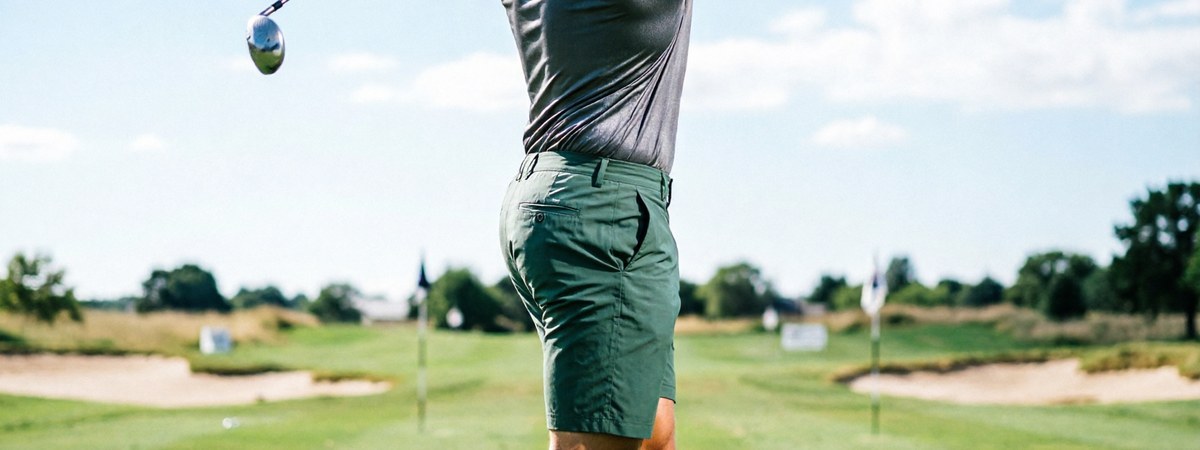
Together, these are the four performance pillars (lightweight breathability, 4-way stretch, quick-dry wicking, UPF 50+) that define a credible golf garment — and the spec sheet a manufacturer must hit consistently.
3. Design Considerations: From Course to Clubhouse
Golf apparel is bought for two venues at once: the fairway and the clubhouse (the "19th hole"). Design has to hold up in both. Key cues that signal premium without sacrificing play:
- Collar architecture. A hidden button-down or self-collar keeps the shirt looking composed all day; reinforced collars hold their shape instead of curling after a few holes.
- Pique texture. Traditional pique knit reads as the modern country-club look — pairing that texture with a technical blend gives the "premium weight, not thin or clingy" hand-feel buyers praise.
- Tailored, athletic fit. Raglan shoulders, a slimmer contemporary cut, and a hem long enough to tuck or untuck bridge on-course function and off-course polish.
- Restrained graphics. Tonal prints, color-blocking, and contrast neck-taping read as high-end; all-over loud sublimation reads as entry-level. The brief is "sharp at the clubhouse, free at the swing."
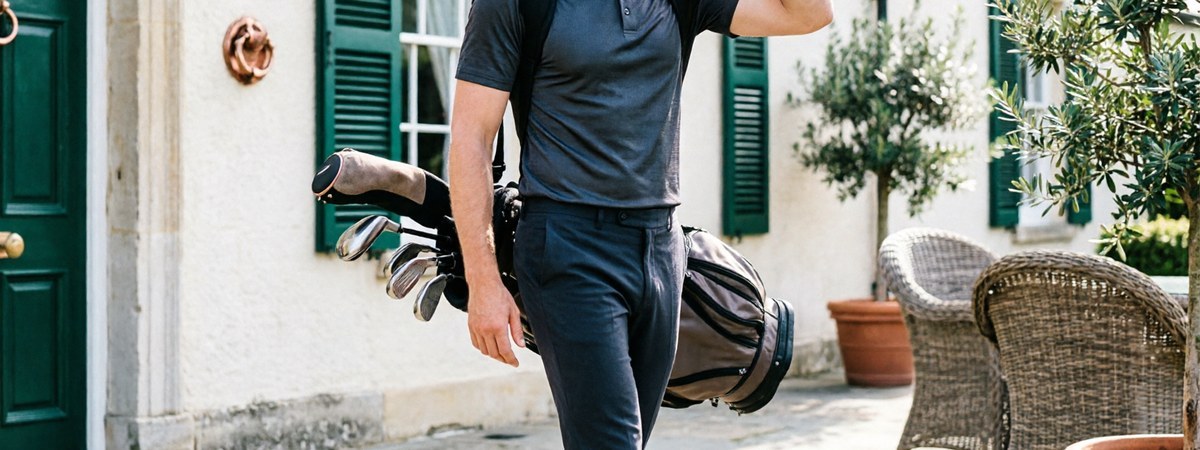
The winner is the piece a customer is happy to wear to a business-casual lunch after the round — which is why ~44% of golf-apparel buyers now wear their gear off the course entirely.
4. Fabric Selection for Golf-Specific Needs
Fabric is where golf manufacturing earns its keep. The workhorse is a polyester–spandex pique, but the exact blend sets the hand-feel and performance:
Birdseye / Tech Pique
Lightweight pique with 3–6% spandex delivers 4-way stretch, breathability, and quick-dry. Common blends: 92% poly / 8% spandex, 94% poly / 6% spandex, or 88% poly / 12% spandex.
COOLMAX blends
Premium polos such as Dunning's Player Pique use ~49% polyester / 48% COOLMAX / 3% spandex for permanent moisture management plus UPF 50+.
UPF construction
UPF is engineered through weave density, UV dyes/coatings, and fiber choice — verified to standards like AATCC 183. It is a manufacturing spec, not a finishing spray.
Sustainable options
Recycled polyester (rPET) is now mainstream — Adidas shipped a 90%-recycled golf line in 2023 — with GRS and OEKO-TEX certified routes available at 140–310 gsm weights.
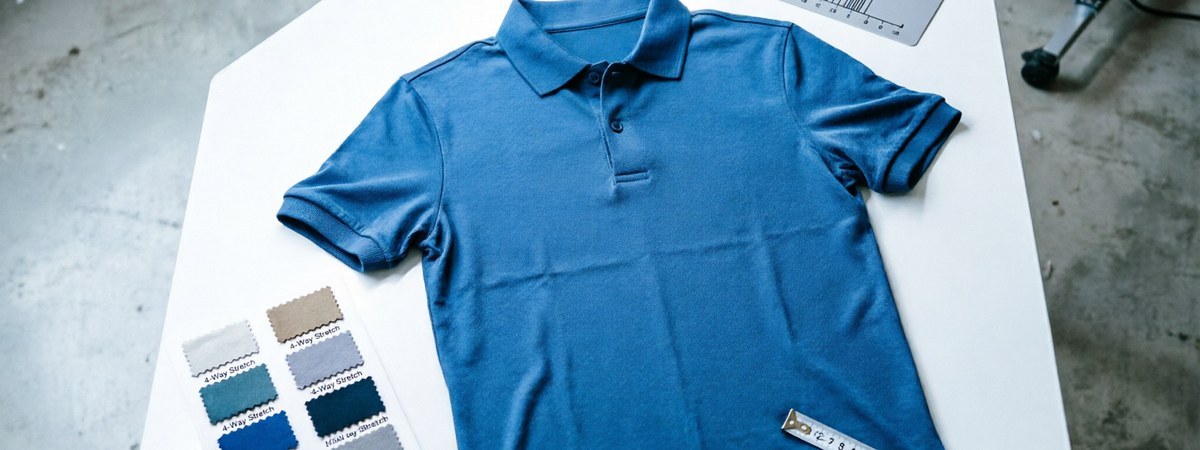
The right mill library lets a brand span matte-to-performance looks while keeping UPF, stretch, and wicking consistent — the foundation for a coherent line.
5. Branding Options for Golf Apparel
Golf is a logo-driven category — club crests, tour marks, and monograms carry status. The manufacturing craft that delivers them includes:
- High-end embroidery. Precision stitching for club badges and brand marks; the most "country-club" finish and the most durable.
- Sublimation. All-over, fade-resistant prints using eco-friendly inks — ideal for bold patterns that never wash out.
- Screen printing & heat transfer. Bold custom-logo placement and reflective or glow finishes for signature looks.
- 3D embroidery & appliqué. Raised texture for premium limited runs.
- Labels & packaging. Woven/damask neck and hem tags, printed labels, and custom poly bags complete the brand impression.
Placement matters as much as the method: a clean left-chest logo, a tonal back yoke, and a subtle sleeve mark read as premium; clutter reads as promo-wear.
6. Customization: Polos, Pants, Shorts, Outerwear
A custom golf program typically spans four pillars, each with its own construction logic:
Polos
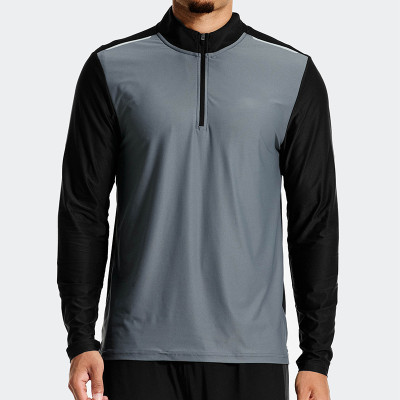
Classic, print, color-block, half-zip, and full-sublimation — the hero SKU. Short and long sleeve, with raglan or set-in sleeves.
Trousers
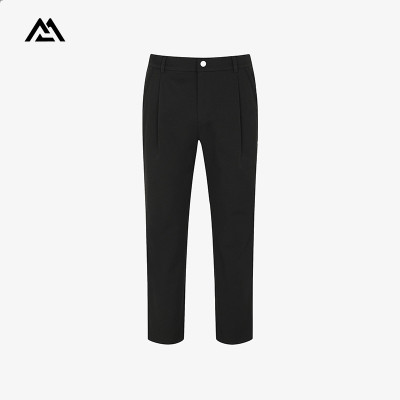
Tailored performance fit, stretch comfort waistband, functional pockets, and a length that works tucked or untucked.
Shorts
Matching the trouser block in a shorter cut for warm-weather rounds and resort play.
Outerwear
Windproof, water-repellent, lightweight vests and quarter-zips for layering across seasons and climates.
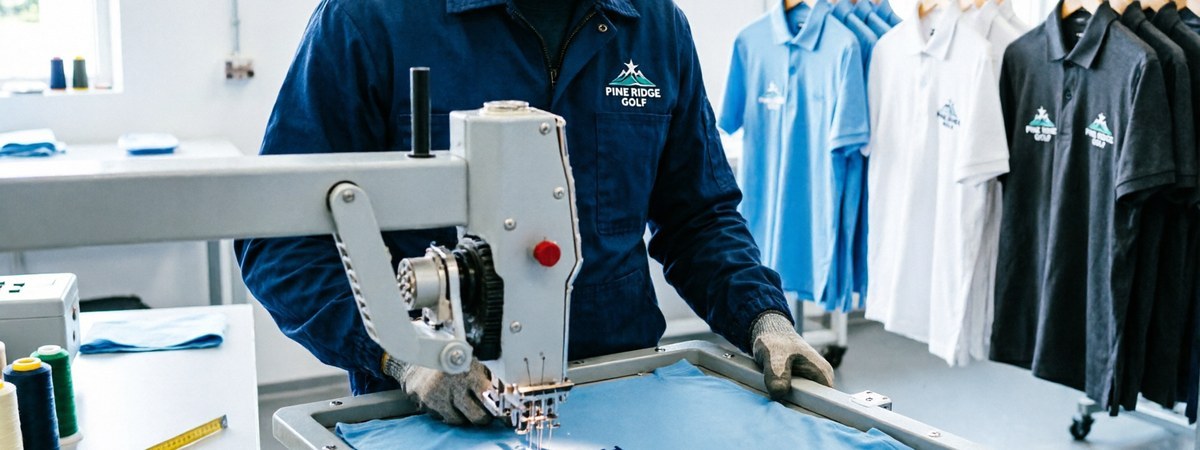
Flexible manufacturers support this range at low minimums — some as low as 50 pieces per style with sampling in 7–10 days — so a new label can launch a coordinated capsule without betting the inventory.
7. How Premium Golf Brands Engineer the Swing
The best commercial products show the spec sheet in action. A few real benchmarks:
- Dunning Player Pique Polo — 49% poly / 48% COOLMAX / 3% spandex, hidden button-down self-collar, UPF 50+, recycled-polyester logo buttons. Reviewers praise its "solid, premium weight" and shape-holding collar.
- Youvee Elite Performance Polo — 88% poly / 12% spandex (180 gsm) with ARPANSA-certified UPF 50+ built-in sleeves and 4-way stretch; a case of sun protection engineered, not sprayed on.
- G/Fore Tech Pique — 94% poly / 6% spandex with odor-inhibiting, moisture-wicking tech pique and unbeatable 4-way stretch for the clubhouse-to-course lifestyle.
- Under Armour Smart Polo (2024) — embeds micro-sensors tracking body temperature and hydration, pointing to the smart-fabric frontier (≈17% of manufacturers now pilot sensor-integrated apparel).
Manufacturing takeaway: the "premium" feel customers describe is the sum of blend, collar construction, and consistent UPF/stretch — all controllable on the factory floor, none achievable by a generic trading company.
8. Partnering with a Golf Apparel Manufacturer
Choosing a golf apparel manufacturer is less about price per unit and more about capability. A true partner offers OEM, ODM, and OBM under one roof, owns its production (no hidden subcontracting), and builds compliance into the line:
- Certifications: BSCI, GRS, OEKO-TEX, and Bluesign — verified, not claimed.
- Testing: fabric strength to ISO 13934 and UV protection to AATCC 183, with 100% inspection rather than random sampling.
- Speed: sampling in 7–10 days vs. 20–30 for slower competitors, and restock reliability at volume.
- Flexibility: low MOQs (from ~50 pieces/style) so brands can test, reorder, and scale without dead stock.
The payoff is visible in real programs: one country club worked with a manufacturer to redesign staff uniforms — non-restrictive polos with full-swing mobility, custom-embroidered logos on polos/hats/jackets, lightweight vests for year-round wear, and sustainable fabric options aligned with the club's eco goals. The result was a uniform members wore proudly on and off the course.
Want a golf apparel partner like that? Start a custom golf polo and trouser program with MontForge →
9. What to Look for in a Golf Apparel OEM/ODM Partner
Shortlist a factory on more than unit price. Check these before you commit:
Fabric library
Do they hold performance piques, COOLMAX, and rPET at multiple weights? A deep library means faster, consistent development.
In-house decoration
Embroidery, sublimation, heat transfer, and 3D embroidery on-site avoid subcontractor quality drift on logos.
UPF & QC verification
Ask for AATCC 183 UV reports and ISO 13934 strength data; 100% inspection should be the standard, not the upsell.
Low-MOQ + fast sampling
50-piece/style starts and 7–10-day sampling let you validate before scaling.
Restock reliability
Can they replenish your hero polo at volume on a predictable calendar? That is the scaling question that matters most.
Compliance paperwork
BSCI / GRS / OEKO-TEX / Bluesign certificates you can actually show a retailer or club buyer.
10. Frequently Asked Questions
How big is the men's golf apparel market?
Estimates put the men's golf clothes market at roughly USD 3.95 billion in 2025, growing toward USD 5.72 billion by 2032 (about 5.4% CAGR). Men's product makes up around 54% of total golf apparel demand, with North America the largest regional market.
What fabric is best for custom golf polos?
A polyester–spandex pique is the workhorse — blends like 92% poly / 8% spandex or 88% poly / 12% spandex give 4-way stretch, breathability, and quick-dry. Premium options add COOLMAX for permanent wicking plus UPF 50+. Recycled polyester (rPET) routes are widely available.
What UPF rating should golf shirts have?
UPF 50+ is the standard for quality golf apparel — it blocks over 98% of UV rays. It is engineered through weave density, UV dyes/coatings, and fiber choice, and should be verified to AATCC 183 rather than assumed.
What is a realistic MOQ for a startup golf brand?
Flexible golfwear manufacturers offer as low as 50 pieces per style, with sampling in 7–10 days. That lets a new label launch a coordinated polo/trouser capsule and reorder based on real sales instead of betting on inventory.
Which branding method looks most premium?
High-end embroidery for club crests and brand marks reads most "country-club," while sublimation handles bold all-over prints that never fade. Placement — clean left-chest, tonal back yoke — matters as much as the technique.
Conclusion
Custom golf apparel manufacturing is the art of making one garment perform on the fairway and look right in the clubhouse. The recipe is specific: four-way stretch and UPF 50+ engineered into the weave, a pique-blend hand-feel that holds its shape, restrained design that travels off-course, and branding — embroidery, sublimation, or heat transfer — applied with precision. The brands winning this category are the ones who treat manufacturing as a technical partnership, not a transaction: low MOQs to validate, in-house decoration to protect the logo, and verified UPF and QC to protect the reputation. If you are building a golf label, the right factory is the one that engineers the swing as seriously as you design the look.
Ready to build your golf apparel line? Start your low-MOQ golf polo and trouser program with MontForge →