Active Athletic Knit: The Workhorse Fabric for Training Shorts, Tees, and Base Layers
Category: Performance & Lifestyle Fabrics Brand: MontForge | Premium Men's Activewear Manufacturer Reading time: ~7 minutes
What Is Active Athletic Knit?
Active Athletic Knit is a broad category of performance knit fabrics engineered specifically for high-output training applications — covering the garments worn closest to the body during gym sessions, HIIT, cross-training, team sports, and studio workouts. Where the 4-Way Stretch Performance Knit covered in Blog 01 is optimised for street running and technical jogger construction, Active Athletic Knit is the fabric architecture behind the highest-contact, highest-output garments in a men's activewear collection: training shorts, performance tees, compression base layers, and tank tops.
The defining characteristics of Active Athletic Knit as a fabric category are moisture-wicking velocity, skin-contact comfort under sustained friction, and dimensional stability under repeated stretch-and-recovery cycles during dynamic training movements. These three parameters — not weight or packability — drive every specification decision in active athletic knit fabric selection.
The primary fiber constructions within this category are:
· 100% Polyester interlock or single jersey: The standard construction for performance training tops and shorts. Fast moisture transport, excellent dimensional stability, low cost, wide availability across GSM ranges.
· Polyester-Spandex blend (88–92% polyester / 8–12% spandex): Adds elastic recovery to the base polyester knit. The correct specification for compression-fit garments, fitted training shorts, and any training top where a close-to-body silhouette must be maintained through full range of motion.
· Nylon-Spandex blend (82–86% nylon / 14–18% spandex): Higher abrasion resistance and superior moisture feel compared to polyester at equivalent GSM. The premium specification for training shorts and base layers where skin-contact quality is a primary brand differentiator.
In short: Active Athletic Knit is the fabric category that determines how a training garment feels during use — the moisture on skin, the resistance against movement, the scratch or softness at friction points. It is the highest-contact fabric in a men's activewear collection and the one where specification errors are most immediately felt by the wearer.
Key Technical Specifications
Property | Polyester Interlock | Polyester-Spandex Knit | Nylon-Spandex Knit |
|---|---|---|---|
Fiber composition | 100% Polyester | 88–92% Polyester / 8–12% Spandex | 82–86% Nylon / 14–18% Spandex |
Fabric weight | 120–180 GSM | 150–220 GSM | 180–240 GSM |
Stretch direction | 2-way | 4-way | 4-way |
Elastic recovery | Low (no spandex) | High (>90%) | Very high (>95%) |
Moisture-wicking rate | High | High | Very high |
Abrasion resistance | Moderate | Moderate | High |
Skin-contact feel | Smooth, cool | Smooth, slightly firmer | Silky, premium |
Pilling resistance | Moderate | Good | Excellent |
Cost tier | Entry | Mid | Premium |
Primary application | Training tees, loose shorts | Fitted shorts, compression layers | Premium base layers, pro-grade shorts |
How Active Athletic Knit Manages Moisture
Moisture management is the primary performance function of active athletic knit — and the most commonly misunderstood parameter when brand owners compare fabric options. The relevant metric is not whether the fabric absorbs moisture, but how quickly it moves moisture away from the skin surface and distributes it across the fabric face for evaporation.
Wicking mechanism in polyester knit Polyester fiber is hydrophobic — it does not absorb water into the fiber itself (moisture regain of approximately 0.4%). Instead, moisture is transported by capillary action through the spaces between the fiber filaments in the yarn bundle. The tighter the filament packing within the yarn, the more capillary pathways exist, and the faster moisture moves from the inner face (skin contact) to the outer face (evaporation surface). This is why high-filament-count polyester yarns — finer individual filaments packed more densely — produce faster-wicking fabrics than low-filament-count constructions at equivalent GSM.
The role of knit structure in moisture distribution Beyond fiber wicking rate, the knit structure determines how moisture is distributed laterally across the fabric face for evaporation. A single jersey knit — the lightest and most open construction — moves moisture quickly but concentrates it in a smaller evaporation zone. An interlock knit — a double-faced construction with two interlocked jersey layers — provides a larger lateral distribution surface and a more even moisture spread, which produces faster overall evaporation from the garment surface. This is why interlock is the preferred construction for training tops where the full fabric surface is the evaporation zone.
Nylon vs. polyester moisture management Nylon fiber has a significantly higher moisture regain than polyester — approximately 4% versus 0.4%. This means nylon actually absorbs a small amount of moisture into the fiber itself, in addition to transporting moisture by capillary action. The practical effect is that nylon-spandex active knits feel drier against the skin at the initial contact point — the fiber absorbs the first fraction of sweat before it builds up at the skin interface — while polyester begins wicking immediately but entirely through capillary transport. For premium base layers where the initial skin feel during the onset of sweating is a brand differentiator, nylon-spandex is the superior specification.
Knit Structures in Active Athletic Fabric
The knit structure — how the yarn loops are interlaced — is as consequential as the fiber type for the final garment performance. The four knit structures most commonly used in active athletic knitwear are:
Single Jersey The lightest and most economical knit construction. One set of needles produces a single-faced fabric with a smooth knit face and a looped purl back. GSM range: 100–160 GSM. Fast moisture transport, excellent drape, low structural stability under stretch — the fabric curls at cut edges, requiring overlocked or bound seam finishing. Primary application: lightweight training tees, tank tops, and liner fabrics for training shorts.
Interlock A double-faced construction produced by two interlocked sets of needles. Both faces have a smooth knit appearance — no visible purl side. Heavier and more dimensionally stable than single jersey. GSM range: 150–220 GSM. Resists edge curl, maintains shape under stretch, excellent moisture distribution across both faces. Primary application: performance training tops, fitted polos, and base layer tops where dimensional stability and premium hand feel are required.
Piqué A textured knit with a raised geometric pattern on the face — typically a small diamond or honeycomb cell. The textured surface reduces skin contact area compared to a smooth interlock, which improves airflow at the skin interface and accelerates moisture evaporation. GSM range: 160–220 GSM. Primary application: training polos, golf and court sport shirts, and outdoor training tops where ventilation is a primary requirement.
Rib Knit A vertical-striped construction produced by alternating knit and purl columns. Highly elastic in the cross-grain direction, with excellent recovery — rib stretches significantly more than jersey or interlock before the yarn structure is stressed. GSM range: 180–300 GSM (heavier due to denser construction). Primary application: waistbands, collar ribs, cuff trim, and compression-fit training tops where high cross-grain stretch is required.
What Garments Is This Fabric Built For?
Active Athletic Knit is the correct fabric specification for five core men's training garment categories:
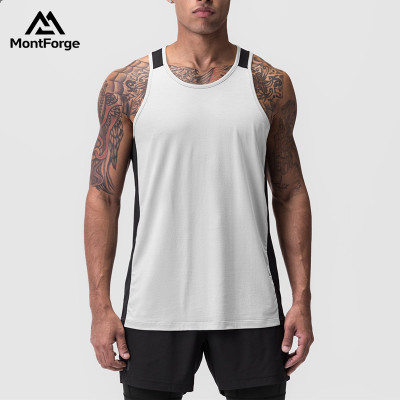
Performance Training Tees and Tank Tops
The standard men's training top — crew neck, V-neck, or racerback tank — is built from 130–170 GSM single jersey or 160–200 GSM interlock in polyester or polyester-spandex. The fabric weight determines the drape and opacity of the finished garment: lighter single jersey (130–150 GSM) produces a featherweight top that moves freely during dynamic training; heavier interlock (180–200 GSM) provides more body and structure for gym-to-street versatility. Anti-microbial treatment (as covered in Blog 06) is a standard spec upgrade for training tops, preventing odour development between washes.
Fitted Training Shorts and Gym Shorts
For fitted training shorts — inseam 5"–7", close-to-body silhouette — polyester-spandex or nylon-spandex knit at 170–220 GSM is the correct specification. The spandex component maintains the fitted silhouette through the full range of squats, lunges, and lateral movements without the shorts riding up or distorting at the seat. For looser training shorts and basketball-influenced shorts, 100% polyester single jersey at 130–160 GSM provides the drape and freedom of movement expected in that silhouette category.
Compression Base Layers
Compression garments — leggings, compression shorts, compression tops — require the highest spandex content in the active athletic knit category: typically 18–25% spandex in a nylon or polyester base. This spandex level produces measurable graduated compression pressure on the muscle groups covered, which is associated with reduced muscle oscillation and vibration during high-impact activity. At this spandex content, the fabric is significantly heavier and firmer than standard training knit — 200–260 GSM — and requires pattern grading that accounts for the compression pressure at the target muscle zones rather than standard ease allowances.
Training Shorts Inner Liner
The inner brief liner in two-in-one training shorts and hybrid shorts is typically constructed from a separate lightweight knit at 80–120 GSM — lighter and softer than the outer shell fabric. The liner fabric sits directly against the skin at the highest-friction zones (inner thigh, groin) and must prioritise skin-contact comfort and flat seam construction over all other parameters. Nylon-spandex at 100–120 GSM with flatlock stitching throughout is the premium specification for training short liners; polyester-spandex at 80–100 GSM is the standard-tier alternative.
Performance Polo Shirts and Sport Shirts
Piqué knit in polyester or polyester-spandex at 180–220 GSM is the standard construction for performance polo shirts targeting the golf, tennis, and court sport categories. The textured piqué surface reduces cling and improves airflow compared to a smooth interlock at equivalent GSM. UPF 50+ treatment (Blog 05) is frequently specified on outdoor sport polos, and anti-microbial treatment is standard for this category given the sustained outdoor activity and lower laundering frequency typical of golf and court sport use patterns.
How Fabric Properties Determine Construction Choices
Active athletic knit's high skin-contact role means construction quality — specifically seam finish quality — has a more immediate impact on the wearer's experience than in any other fabric category in this series.
Flatlock stitching as the standard construction
The defining seam construction for active athletic knitwear is flatlock stitching: a two-thread construction where both seam allowances are folded outward and the stitch runs across the flat seam junction, creating a reversible seam with no raised ridge on either side. Against the skin, a flatlock seam is imperceptible during movement — there is no seam edge to create friction, abrasion, or pressure points during sustained training. Conventional overlocked seams in training garments produce chafing at the inner thigh, underarm, and shoulder seam positions during high-mileage or high-repetition use — flatlock construction eliminates this failure mode entirely.
For premium construction, all body seams — side seams, shoulder seams, underarm seams — are flatlock. Only the hem and neckband seams use a standard coverstitch or lockstitch finish, where the seam is not in direct skin contact.
Seamless and minimal-seam construction
For compression base layers and fitted training shorts where seam friction is a critical comfort parameter, seamless knitting — producing the garment or garment panel on a circular knitting machine without cut-and-sew construction — eliminates seams entirely at the most friction-prone positions. Seamless construction requires specific yarn weights and knit machine specifications; it is not available across all active athletic knit constructions but is the correct specification for compression garments where performance and comfort are the primary positioning.
Waistband construction for training shorts
The waistband of a training short is a structural component — it must stay in position during dynamic movement, distribute compression evenly around the waistline, and avoid rolling or folding under load. The three construction approaches in order of premium level are:
· Exposed elastic with internal channel: A standard elastic band inserted into a folded waistband channel. Effective and economical; the elastic can be replaced if it degrades. Not the premium specification for technical training shorts.
· Covered elastic with integrated drawcord: Elastic encased in a knit or woven waistband with a drawcord for adjustable cinching. The standard specification for mid-tier training shorts — provides adjustability and a cleaner exterior profile than exposed elastic.
· Bonded waistband with silicone grip strip: An elastic waistband bonded to the outer shell fabric using heat-welded adhesive, with a silicone grip strip on the interior face to prevent the waistband from rising during movement. The premium construction for fitted training shorts — no visible stitching on the outer waistband face, maximum grip during dynamic training.
Gusset and crotch construction
As with technical joggers (Blog 01), a diamond or triangular crotch gusset in training shorts eliminates central seam binding and provides unrestricted range of motion in deep flexion. The gusset fabric for training shorts is typically a lighter, more breathable mesh or lightweight knit panel — providing ventilation at the highest heat zone of the garment — rather than the same fabric as the outer shell.
Branding and graphic application
Active athletic knit accepts the full range of performance branding methods:
· Sublimation printing: The preferred method for polyester athletic knit. Dye bonds at fiber level — no surface layer, no cracking or peeling under repeated stretch and laundering. Full-panel sublimation enables complex gradient and photographic-quality graphics across the full garment surface.
· Screen printing: Compatible on polyester knit at chest and back positions. Requires a flexible low-cure ink formulated for stretch fabrics — standard plastisol inks will crack. Water-based or discharge inks are the preferred screen print specification for polyester training tees.
· Heat transfer print: Compatible and reliable on stable interlock constructions. Less suitable on single jersey due to the fabric's tendency to curl and distort at cut edges during heat press application.
· Embroidery: Compatible on interlock at chest and sleeve positions. Requires a stabilising backing to prevent the knit from distorting under the embroidery frame during stitching. Not recommended on single jersey without stabilisation.
Compatible Tech Coating Upgrades
Coating | Function | Recommended for Athletic Knit | Notes |
|---|---|---|---|
Anti-microbial (silver or zinc) | Prevents odour-causing bacterial growth | All training tops and base layers | Fiber-integrated for wash permanence |
UPF 50+ absorber | UV protection for outdoor training garments | Outdoor training tops, sport polos | Fiber-integrated recommended |
Anti-pilling | Reduces fiber surface degradation under abrasion | All polyester knit training garments | Surface finish; 30–40 cycle durability |
Moisture-wicking enhancer | Increases capillary wicking velocity on standard polyester | Entry-level polyester constructions | Surface finish; degrades with washing |
Anti-static | Reduces static build-up in synthetic training layers | Fleece-lined training tops | Surface finish |
Note on moisture-wicking finish: A moisture-wicking enhancer applied as a surface finish to a standard polyester knit is not the same as inherent moisture management in a high-filament-count polyester or nylon construction. Surface finish wicking performance degrades with washing — typically within 15–20 cycles — whereas fiber-level wicking is a permanent property of the construction. For garments marketed with a moisture management claim, specify the claim based on fiber construction, not a surface finish.
How to Pair Active Athletic Knit Within a Collection
Active Athletic Knit occupies the core training layer position in a men's activewear collection — it is the category with the highest unit volume and the highest repeat purchase rate, because these garments are used most frequently and replaced most regularly.
In the collection architecture developed across this series:
· 4-Way Stretch Performance Knit (Blog 01): Technical jogger and street running pant — the lower-body active layer for outdoor running
· Active Athletic Knit (this article): Training tops, shorts, and base layers — the full-body active layer for indoor and outdoor training
· Ultralight Windproof (Blog 02) and Softshell (Blog 03): Outer layers over the active knit base for outdoor conditions
· Tech Coatings (Blog 06): Applied to active knit fabrics to add anti-microbial, UPF, or anti-pilling performance upgrades
The pairing logic within the active knit category itself: polyester interlock training tee + polyester-spandex fitted shorts is the entry-level training set; nylon-spandex base layer top + nylon-spandex compression shorts is the premium training set. Both pairings use the same construction logic — flatlock seams, gusset construction, covered elastic waistband — at different fiber and price tiers.
Sourcing and Production Notes for Private Label Brands
Minimum Order Quantity: Active athletic knit fabrics are among the most accessible in the activewear category for independent brands — wide availability across the polyester and polyester-spandex constructions means MOQ requirements are lower than for specialist fabrics like bonded softshell or UPF-treated wovens. Nylon-spandex constructions carry a higher MOQ due to the smaller production scale of premium nylon knit mills. Contact the MontForge technical team for current MOQ by fiber type and GSM.
Sample lead time: 7–12 days for standard polyester and polyester-spandex constructions — the shortest sample lead time in the series because these fabrics are widely stocked. Nylon-spandex and seamless constructions extend to 12–18 days due to fabric sourcing and machine setup requirements.
Bulk production timeline: 30–45 days, covering fabric incoming inspection (including wash-shrinkage and elastic recovery testing), automated cutting, flatlock and coverstitch construction, waistband bonding where specified, and QC inspection before export packaging.
Wash shrinkage testing: Active athletic knit fabrics — particularly polyester-spandex blends — can exhibit significant dimensional change on first laundering if not pre-shrunk at the mill. MontForge conducts wash-shrinkage testing on all incoming fabric lots to AATCC 135 standard. Fabrics exceeding 3% dimensional change in either warp or weft direction are rejected or pre-shrunk before cutting begins. This step prevents finished-garment dimensional variance that is the most common quality complaint in active knitwear production.
Sublimation printing on polyester knit: Sublimation printing requires 100% polyester substrate — spandex content up to 15% is compatible; above 15% spandex, sublimation ink penetration is reduced and colour saturation decreases. For full-panel sublimation on compression garments with high spandex content, a polyester-dominant face yarn (with spandex in a separate structural layer) is the correct fabric engineering approach.
GRS-certified recycled options: Active athletic knit is one of the most developed categories for GRS-certified recycled polyester (rPET). MontForge sources rPET active knit across the full GSM range — 120 GSM lightweight single jersey to 220 GSM interlock — from verified GRS-certified mills. Recycled nylon-spandex is available at select GSM ranges. Performance and moisture management are equivalent to virgin fiber at equivalent construction. Contact the sourcing team for current rPET availability by construction type.
Summary: When Active Athletic Knit Is the Right Specification
Active Athletic Knit — in polyester interlock, polyester-spandex, or nylon-spandex construction across 120–260 GSM — is the technically correct fabric specification when the product brief requires:
· Maximum moisture transport velocity away from the skin during sustained high-output training
· Skin-contact comfort under friction at seam lines, waistbands, and gusset positions
· Dimensional stability across repeated stretch-and-recovery cycles in squats, lunges, and dynamic movements
· A base fabric that accepts anti-microbial, UPF, and anti-pilling coating upgrades for functional product differentiation
· The highest unit-volume category in a men's activewear collection — the fabric that drives repeat purchase and brand loyalty through daily use
For lower-body garments designed for outdoor running and street wear, the correct specification is 4-Way Stretch Performance Knit (Blog 01). For outer layers worn over the active knit base, the correct specification is Ultralight Windproof (Blog 02), Softshell (Blog 03), or Nylon Ripstop (Blog 04) depending on conditions. Active Athletic Knit is the foundation every other fabric in the collection layers over or pairs with.
Frequently Asked Questions
What is active athletic knit fabric?
Active athletic knit is a category of performance knit fabrics constructed primarily from polyester, polyester-spandex, or nylon-spandex blends at 120–260 GSM, engineered for high-output training applications. The category encompasses the fabrics used in training tees, performance shorts, compression base layers, and tank tops — the highest-contact garments in a men's activewear collection. The defining performance parameters are moisture-wicking velocity, skin-contact comfort under friction, and dimensional stability under repeated stretch-and-recovery cycles.
What is the difference between single jersey and interlock knit in activewear?
Single jersey is a single-faced knit construction — one set of needles, one face layer — producing a lightweight fabric (100–160 GSM) with a smooth knit face and looped purl back. It is fast-wicking and drapey but prone to edge curl and lower dimensional stability. Interlock is a double-faced construction — two interlocked sets of needles — producing a heavier fabric (150–220 GSM) with smooth surfaces on both faces. Interlock is more dimensionally stable, resists edge curl, and provides better lateral moisture distribution across both fabric faces, making it the preferred construction for structured training tops and performance polos.
Why does nylon-spandex feel better than polyester-spandex against the skin?
Nylon fiber has a moisture regain of approximately 4% versus 0.4% for polyester. This means nylon absorbs a small amount of moisture directly into the fiber at the point of skin contact, before capillary wicking begins — producing a drier initial skin feel during the onset of sweating. Additionally, nylon fiber has a rounder cross-section than standard polyester, which produces a smoother, silkier contact feel. Nylon is also more abrasion-resistant, preventing the pilling and surface degradation that reduces the skin-contact quality of polyester training shorts over repeated use.
What is flatlock stitching and why does it matter in training garments?
Flatlock stitching is a two-thread seam construction where both seam allowances are folded outward and the stitch runs across the flat seam junction — creating a reversible seam with no raised ridge on either face. In training garments, seams at the inner thigh, underarm, and shoulder positions are in constant contact with moving skin. Conventional overlocked seams create a raised edge that causes chafing and abrasion at these positions during sustained training. Flatlock eliminates the raised edge entirely, making the seam imperceptible during movement. It is the standard seam construction for all body seams in premium active athletic knitwear.
What GSM should training shorts be?
For fitted training shorts with a close-to-body silhouette, polyester-spandex or nylon-spandex knit at 170–220 GSM is the standard specification — providing enough body weight to maintain shape without the shorts distorting or becoming translucent at stretch points. For looser training shorts with a relaxed silhouette, 100% polyester single jersey at 130–160 GSM provides the drape and freedom of movement expected in that cut. For compression shorts, 200–260 GSM in a high-spandex construction is correct.
Can active athletic knit be sublimation printed?
Yes, on polyester-dominant constructions. Sublimation printing drives dye directly into the polyester fiber — no surface layer is added, meaning the graphic cannot crack or peel regardless of stretch or wash cycles. Full-panel sublimation across the entire garment surface is possible, enabling complex colour gradients and photographic-quality graphics. The substrate must be at least 85% polyester for effective sublimation ink penetration and colour saturation — high-spandex constructions above 15–20% spandex content may show reduced colour saturation at sublimation.
MontForge is a verified premium men's activewear manufacturer with over eight years of production experience serving independent European and global private labels. Core product competencies span technical outerwear and shells, technical joggers and track pants, hoodies and sweatshirts, and gym and training wear. GRS-certified recycled material programs are available across all product categories.
Previous in the Performance & Lifestyle Fabrics series: Tech Coatings Demystified: DWR, Anti-Microbial, and When to Apply Each
Next in the Performance & Lifestyle Fabrics series: Fly-Knit Performance Fabric: Seamless Construction and the Garments It Enables