UPF 50+ UV-Protection Fabric: How Sun-Block Textiles Work and Where to Use Them
Category: Performance & Lifestyle Fabrics Brand: MontForge | Premium Men's Activewear Manufacturer Reading time: ~7 minutes
What Is UPF 50+ Fabric?
UPF 50+ fabric is a textile engineered to block at least 98% of ultraviolet radiation — both UVA and UVB wavelengths — from reaching the skin. UPF stands for Ultraviolet Protection Factor, the apparel industry's equivalent of the SPF rating used for sunscreen. A UPF 50 rating means that of the UV radiation striking the fabric surface, only 1 in 50 units (2%) passes through to the skin. A UPF 50+ rating — the maximum classification under the Australian/New Zealand Standard AS/NZS 4399, which is the globally referenced benchmark — indicates that UV transmittance is below 2%.
Unlike sunscreen, which degrades with sweat, water, and time, a properly constructed UPF fabric delivers consistent, quantified UV protection for the life of the garment — without reapplication, without the skin feel of sunscreen, and without the compliance requirement of remembering to apply it. For men's activewear designed for outdoor use, this makes UPF rating a functional specification with direct consumer health implications, not a marketing claim.
In short: UPF 50+ fabric blocks 98%+ of UV radiation through its construction and finish — making it the technically correct specification for any outdoor activewear garment where prolonged sun exposure is a realistic use condition.
Key Technical Specifications
Property | Specification |
|---|---|
UPF rating | UPF 50+ (UV transmittance <2%) |
Testing standard | AS/NZS 4399 (Australian/New Zealand Standard — global benchmark) |
Primary fiber options | High-density Polyester, Nylon, or treated Cotton blends |
Fabric weight | 150–260 GSM depending on garment category |
UV-blocking mechanism | Tight weave density + UV-absorbing fiber or finish |
UVA blocking | ≥97.5% |
UVB blocking | ≥98% |
Wash durability | Rating maintained for 40+ wash cycles (finish-based); permanent (fiber-based) |
Stretch compatibility | 2-way or 4-way stretch variants available |
How UPF Protection Works in Fabric
UPF protection in a textile is achieved through one or a combination of three mechanisms. Understanding which mechanism is in use matters for brand owners because it directly affects how the UPF rating holds up over the garment's service life.
Mechanism 1: Weave density The simplest form of UV protection is physical — a fabric woven or knitted tightly enough that the gaps between threads are too small for UV photons to pass through. Denim, for example, achieves UPF 1,700 simply through its dense weave, with no UV-specific treatment. For lightweight performance fabrics, however, achieving UPF 50+ through weave density alone requires a GSM that is impractical for active outdoor use. Weave density is a contributing factor in all UPF fabrics, but is rarely sufficient on its own for lightweight constructions.
Mechanism 2: UV-absorbing fiber treatment A UV absorber — typically a benzotriazole or triazine compound — is applied to the fiber at the yarn-dyeing or finishing stage. The compound absorbs UV radiation at the molecular level and converts it to heat, preventing transmission through the fabric. This treatment is integrated into the fiber itself when applied at the yarn stage, producing a rating that is wash-permanent — it does not degrade with laundering because the absorber is not a surface coating. When applied at the finishing stage (pad application after weaving), the rating is durable to approximately 40–50 wash cycles before requiring re-treatment.
Mechanism 3: Optical brighteners and titanium dioxide Some UPF fabrics use titanium dioxide (TiO₂) particles incorporated into the fiber during production. TiO₂ is a broad-spectrum UV scatter agent — it physically deflects UV radiation at the fiber surface rather than absorbing it. This approach is common in high-performance nylon and polyester UPF fabrics and produces a wash-permanent rating. Optical brighteners, by contrast, are a lower-cost surface treatment that improves measured UPF values by reflecting UV — but these compounds are not wash-permanent and are not an acceptable specification for garments marketed with a UPF claim.
The correct specification for private label brands: For any garment marketed with a UPF 50+ claim, the UV protection must be achieved through fiber-integrated UV absorber treatment or TiO₂ incorporation — not optical brighteners or surface-only finishes. MontForge specifies fiber-integrated UV treatment on all UPF-rated fabric lots and provides test documentation to ASTM D6603 and AS/NZS 4399 standards for private label compliance requirements.
What Reduces UPF Rating in Use
UPF ratings are tested on new, dry fabric under laboratory conditions. Real-world use conditions affect the measured protection level — and brand owners should understand these factors when specifying UPF garments.
Factor | Effect on UPF | Magnitude |
|---|---|---|
Fabric stretching | Increases gap between threads; reduces UPF | Significant on knit constructions; up to 30% reduction at full stretch |
Wet fabric | Water fills thread gaps; typically increases UPF in dense fabrics | Minor improvement in most cases |
Repeated washing | Degrades finish-based treatments; no effect on fiber-integrated treatments | Significant for finish-based; negligible for fiber-integrated |
Fabric colour | Darker colours absorb more UV; lighter colours transmit more | Moderate — dark fabrics 10–15 UPF points higher than light at equivalent construction |
Fabric weight | Heavier fabrics have more fiber per unit area; higher UPF | Moderate — relevant when comparing constructions within the same fiber type |
Abrasion and pilling | Physically damages fiber surface; degrades UV barrier | Minor in normal use; significant in high-abrasion applications |
The implication for garment design: UPF 50+ construction must account for the reduction in protection under stretch. A fabric that measures UPF 60 in the relaxed state may fall to UPF 42 — below the 50+ threshold — at full lateral stretch. For fitted activewear in UPF-rated constructions, MontForge specifies fabrics that maintain UPF 50+ at the stretch levels required by the pattern — confirmed by stretch-state UPF testing before sampling is approved.
What Garments Is This Fabric Built For?
UPF 50+ fabric is the correct specification for outdoor men's activewear categories where the wearer is exposed to direct solar radiation for extended periods and where physical coverage is providing the primary sun protection:
Trail Running and Road Running Tops and Shorts
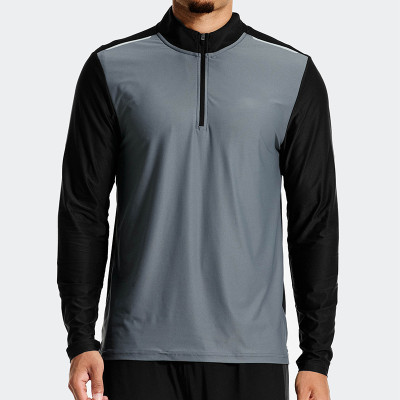
The running category is the primary UPF application in men's activewear. A UPF 50+ long-sleeve running top provides consistent, calibrated UV protection across a two- to four-hour run — regardless of sweat, water exposure, or the compliance failures that affect sunscreen application in practice. For trail runners at altitude, where UV intensity increases approximately 4% per 300 metres of elevation gain, UPF-rated fabric is a genuine performance safety specification, not an optional feature.
Cycling Jerseys and Bib Shorts
Cyclists face sustained UV exposure across the arms, upper back, and thighs — the areas covered by jersey and bibshort fabric. A UPF 50+ construction in the jersey and bib panels provides protected coverage across these high-exposure zones. The lightweight polyester knit constructions standard in cycling apparel are well-suited to UV-absorber treatment at fiber level, maintaining UPF rating across the stretch cycles inherent in the cycling position.
Golf, Tennis, and Court Sport Polos and Shorts
Court and course sports involve sustained outdoor exposure with relatively low aerobic output compared to running — meaning the garment is worn in direct sun for longer periods at lower sweat volumes. UPF 50+ polo shirts and shorts in moisture-wicking polyester or performance cotton blends address this use case, providing UV protection with the structured, polished aesthetic expected in golf and tennis categories.
Outdoor Training Tops, Fishing Shirts, and Adventure Travel Shirts
The long-sleeve sun shirt — a UPF 50+ woven or knit top designed for sustained outdoor activity in high-UV environments — is one of the fastest-growing categories in men's outdoor apparel. For private label brands targeting the adventure travel, fishing, and outdoor training markets, UPF 50+ long-sleeve shirts in lightweight nylon or polyester provide a product with a clear, quantified functional benefit that justifies premium retail pricing.
How Fabric Properties Determine Construction Choices
UPF protection imposes specific construction requirements beyond the fabric specification itself — choices made at the pattern, seam, and finishing stages can either preserve or compromise the garment's rated UV protection.
Coverage and pattern engineering
UPF fabric only protects the skin it covers. For a garment marketed with a UPF rating, pattern engineering must account for coverage gaps at the collar, sleeve hem, pocket openings, and any mesh ventilation panels. The key decisions are:
· Collar construction: A raised collar or stand collar with UPF-rated fabric provides additional neck protection — the base of the neck and the posterior triangle are among the highest skin-cancer-incidence zones in outdoor athletes. A simple crew neck leaves these areas exposed regardless of the fabric UPF rating
· Sleeve length and cuff coverage: For long-sleeve UPF shirts, the cuff must extend to cover the dorsal wrist — the area most commonly missed in sunscreen application and most commonly exposed during running, cycling, and racquet sports
· Mesh ventilation panels: Mesh panels inserted for breathability will have a significantly lower UPF rating than the base fabric — often UPF 10–20 in an open-construction mesh. If the garment carries a UPF 50+ claim, mesh panels must be positioned in areas that do not create high-UV-exposure coverage gaps (typically underarm and lateral body panels, not shoulder or back yoke)
Seam placement and stress point reinforcement
In fitted UPF activewear — particularly running tops and cycling jerseys — seam placement affects both comfort and UV coverage continuity. The correct construction approach is flatlock stitching at all body seams, which keeps the seam allowance flat against the skin rather than creating a ridge that could displace fabric and create a gap in UV coverage at the seam line.
Garment labelling and compliance documentation
Any garment marketed with a UPF 50+ claim requires formal test documentation to AS/NZS 4399 or ASTM D6603 standard. This applies to both the fabric and the finished garment — a fabric test certificate is not sufficient for retail compliance if the garment construction introduces coverage gaps or stretch conditions that reduce the effective UPF below 50. MontForge provides both fabric-level and finished-garment-level UPF test documentation on request for private label compliance and retailer onboarding requirements.
Branding and graphic application
UPF fabric is compatible with all standard activewear branding methods, with one consideration: branding applied at high-UV-exposure zones (shoulder, upper back, forearm) must not compromise the continuity of UV protection at those positions.
· Sublimation printing: The dye is driven into the fiber — no surface layer is added, UV protection at the print zone is unchanged. The preferred branding method for UPF-rated running and cycling apparel
· Heat transfer print: A surface layer is added. At chest and sleeve positions, this does not affect UV protection. At back yoke and shoulder positions, test the heat transfer substrate independently for UPF — the transfer material itself may have a lower UPF rating than the base fabric beneath it
· Embroidery: Thread coverage at embroidered zones is dense and provides high UPF — embroidery at logo positions does not reduce UV protection. The needle penetrations in the base fabric are sealed by the thread itself
Compatible Fabric Constructions for UPF 50+
UPF 50+ treatment is not limited to a single fabric type — it can be applied across a range of base constructions, each suited to a different garment category:
Base Fabric | GSM Range | Stretch | Best Garment Application |
|---|---|---|---|
Lightweight polyester knit | 130–170 GSM | 4-way | Running tops, cycling jerseys, trail vests |
Nylon stretch woven | 120–160 GSM | 2-way | Sun shirts, fishing shirts, adventure travel tops |
Performance polyester piqué | 180–220 GSM | 2-way | Golf and tennis polos |
Cotton-modal blend (treated) | 200–260 GSM | 2-way | Lifestyle sun shirts, casual outdoor tops |
Nylon ripstop (treated) | 80–120 GSM | Minimal | Packable sun shirts, outdoor shell tops |
Note on cotton blends: Natural cotton fiber does not inherently provide high UPF — a standard white cotton T-shirt measures approximately UPF 5–7. Cotton blends achieve UPF 50+ through UV-absorber treatment at the fiber or finishing stage. The treatment is compatible with cotton but requires confirmation at the fabric sourcing stage that the treatment method is wash-durable — finish-only treatments on cotton degrade faster than on synthetic fiber due to cotton's higher moisture absorption in laundering.
How to Pair UPF Fabric Within a Collection
UPF 50+ fabric is a functional upgrade layer in a men's outdoor activewear collection — it does not define a separate garment category but upgrades existing categories with a quantified functional benefit. The positioning strategy for private label brands is straightforward:
The base garment construction (running top, cycling jersey, outdoor shirt) is determined by the performance requirements of the category. UPF 50+ treatment is then specified as a fabric upgrade for any SKU in the collection that will be worn in direct sun for extended periods. This allows a brand to build a UPF-rated sub-line within an existing collection without developing new silhouettes — the same pattern, in UPF-rated fabric, with compliant labelling and test documentation, becomes a differentiated product with a clear functional story.
In a MontForge collection framework, UPF 50+ fabric pairs naturally with:
· Active Athletic Knit (Blog 07) as the base construction for running and training tops — UPF treatment applied at the fabric stage upgrades the knit from a standard training top to a sun-protective performance garment
· Nylon Ripstop (Blog 04) for packable sun shirts and outdoor shell tops — lightweight ripstop with UPF treatment and DWR provides a dual-function outer layer for high-UV outdoor applications
· Quick Dry Fabric (Blog 10) for trail running and water-sport applications — where UPF protection and moisture management are required simultaneously
Sourcing and Production Notes for Private Label Brands
Minimum Order Quantity: UPF 50+ fabric is available across multiple base constructions and denier weights. MOQ varies by fabric type and treatment method — fiber-integrated UV treatment requires minimum lot sizes at the yarn stage; finish-based treatment can be applied at lower quantities. Contact the MontForge technical team for current MOQ by fabric construction and treatment method.
Sample lead time: 10–18 days. UPF fabric sourcing requires confirmation of the UV treatment method and wash-durability specification before sampling begins. Finished garment UPF testing adds 3–5 days to the sample review timeline if test documentation is required before bulk approval.
Bulk production timeline: 35–55 days, covering UPF fabric incoming inspection, UV transmittance testing on incoming lot to AS/NZS 4399, flatlock stitching and seam construction, and finished garment labelling compliance review before export packaging.
UPF test documentation: MontForge provides UPF test certificates to AS/NZS 4399 and ASTM D6603 standards for both fabric lots and finished garments. For brands selling into Australian, European, or North American retail channels where UPF labelling is subject to regulatory oversight, finished-garment test documentation is required — fabric-level certificates alone are not sufficient for most retail compliance programs.
Stretch-state testing: As noted above, UPF rating under stretch is a critical quality parameter for fitted activewear. MontForge conducts stretch-state UPF testing on all fitted UPF garment samples to confirm that the rating is maintained at the pattern's maximum stretch condition before bulk production approval.
GRS-certified recycled options: UPF 50+ treatment is compatible with GRS-certified recycled polyester and recycled nylon base fabrics. Recycled fiber variants achieve equivalent UPF ratings to virgin fiber at equivalent construction. Available across lightweight knit and woven constructions — contact the sourcing team for current availability by GSM and fabric type.
Summary: When UPF 50+ Fabric Is the Right Specification
UPF 50+ fabric is the technically correct specification when the product brief requires:
· Quantified, consistent UV protection that does not degrade with sweat, water exposure, or reapplication failure
· A sun-protection claim that is substantiated by formal test documentation and compliant with retail labelling requirements
· Outdoor activewear for running, cycling, trail, golf, or adventure travel categories where prolonged solar exposure is a realistic use condition
· A functional product differentiation story that justifies a price premium within an existing garment category
For garments where UV protection is incidental rather than primary — indoor training, urban athleisure, or cold-weather outerwear — UPF specification adds cost without meaningful consumer benefit. The correct approach is to specify UPF treatment only on the SKUs in a collection where outdoor, sun-exposed use is the intended scenario.
Frequently Asked Questions
What does UPF 50+ mean in fabric?
UPF 50+ means that the fabric blocks at least 98% of ultraviolet radiation — both UVA and UVB — from reaching the skin. The rating is determined by laboratory testing to the AS/NZS 4399 standard. Only 1 in 50 units of UV radiation striking the fabric surface passes through. UPF 50+ is the maximum classification under this standard; a higher numerical UPF does not represent a meaningfully higher level of protection above this threshold.
How is UPF different from SPF?
SPF (Sun Protection Factor) measures protection against UVB radiation only and is used to rate sunscreen products. UPF measures protection against both UVA and UVB radiation and is used to rate fabric and clothing. A UPF 50 garment provides broad-spectrum UV protection equivalent to — and in practice more reliable than — a high-SPF sunscreen, because the fabric does not degrade with sweat, swimming, or the passage of time during wear.
Does washing reduce UPF protection?
It depends on the UV treatment method. Finish-based UV treatments applied at the fabric surface degrade with washing — typically maintaining effective UPF 50+ for 40–50 wash cycles before re-treatment is needed. Fiber-integrated UV treatments — where the UV absorber or TiO₂ is incorporated into the yarn itself during production — are wash-permanent and do not degrade with laundering. MontForge specifies fiber-integrated treatment on all UPF-rated fabrics to ensure wash-permanent protection.
Does stretching reduce UPF protection?
Yes. Stretching a knit fabric increases the gap between threads, which increases UV transmittance. A fabric measuring UPF 60 in the relaxed state may measure UPF 40–45 at full lateral stretch — below the 50+ threshold. For fitted UPF activewear, stretch-state UPF testing is required to confirm that the rating is maintained at the maximum stretch condition the garment will experience in use. MontForge conducts stretch-state testing on all fitted UPF garment samples.
What colours provide the best UPF protection?
Darker colours absorb more UV radiation and provide higher UPF ratings at equivalent fabric construction — dark navy, black, and deep red fabrics typically achieve 10–15 UPF points higher than white or light yellow at the same GSM and weave density. However, with a fiber-integrated UV treatment, even light-coloured fabrics reliably achieve UPF 50+ — colour choice is therefore not a constraint for UPF-rated collections using treated fabrics.
Do I need formal test documentation to sell UPF-rated garments?
Yes, in most markets. Australia and New Zealand (AS/NZS 4399), the United States (ASTM D6603 and FTC guidelines), and the European Union (EN 13758) all have regulatory frameworks governing UPF labelling claims on apparel. Selling garments with a UPF 50+ label without supporting test documentation exposes the brand to regulatory action and retailer delisting. MontForge provides formal test documentation for both fabric lots and finished garments on request.
MontForge is a verified premium men's activewear manufacturer with over eight years of production experience serving independent European and global private labels. Core product competencies span technical outerwear and shells, technical joggers and track pants, hoodies and sweatshirts, and gym and training wear. GRS-certified recycled material programs are available across all product categories.
Previous in the Performance & Lifestyle Fabrics series: Nylon Ripstop: Why This Grid-Weave Fabric Belongs in Every Technical Outerwear Line
Next in the Performance & Lifestyle Fabrics series: Tech Coatings Demystified: DWR, Anti-Microbial, and When to Apply Each