Fly-Knit Performance Fabric: Seamless Construction and the Garments It Enables
Category: Performance & Lifestyle Fabrics Brand: MontForge | Premium Men's Activewear Manufacturer Reading time: ~7 minutes
What Is Fly-Knit Performance Fabric?
Fly-Knit Performance Fabric — also referred to as engineered knit, precision knit, or warp-knit jacquard — is a textile produced by computerised flat-knitting or warp-knitting machines that construct the garment panel or full
garment geometry directly from yarn, without the intermediate step of producing a flat fabric that is subsequently cut and sewn. The knitting machine reads a digital pattern file and constructs the fabric in the exact shape of the finished panel — or the finished garment — knitting different yarn weights, stitch densities, and fiber types into specific zones of the structure as the machine progresses.
The defining characteristic is not the fiber type — fly-knit constructions use polyester, nylon, spandex, and blended yarns across a range of weights — but the fabrication method: a single continuous knitting process that integrates structural engineering, zonal performance differentiation, and seam elimination into one production step.
The term "Fly-Knit" as used in activewear originates from Nike's trademarked Flyknit technology introduced in footwear in 2012, but the underlying engineered knit technique is a broader industry methodology — not brand-exclusive — applied across performance apparel, footwear uppers, and technical accessories by multiple manufacturers globally.
In short: Fly-Knit Performance Fabric is the construction method that allows different fabric properties to exist in different zones of the same garment — dense structure at load-bearing positions, open mesh at ventilation zones, stretch panels at movement-critical areas — all produced in a single knitting process without cut-and-sew assembly at those zone boundaries.
Key Technical Specifications
Property | Specification |
|---|---|
Construction method | Computerised flat-knit or warp-knit jacquard |
Primary fibers | Polyester, nylon, spandex, or blended multi-yarn constructions |
Fabric weight range | 80–220 GSM (varies significantly by zone within a single garment) |
Seam configuration | Zero-seam or minimal-seam (engineered panel shape eliminates cut edges) |
Zonal differentiation | Stitch density, yarn weight, fiber type, and stretch modulus — variable by zone |
Stretch capability | 2-way to 4-way depending on yarn and stitch specification |
Surface texture options | Smooth, textured, perforated, raised jacquard — programmable |
Minimum order complexity | High — requires digital pattern file development before production |
Lead time sensitivity | Longer sampling phase — pattern file development adds 5–10 days vs standard knit |
How Fly-Knit Construction Works
Understanding the fabrication process clarifies why fly-knit garments perform differently from standard cut-and-sew active athletic knit — and why they carry a higher development cost that must be accounted for in the collection planning and pricing strategy.
Standard cut-and-sew construction vs. fly-knit In standard cut-and-sew active athletic knitwear (Blog 07), the production sequence is: produce flat fabric → cut panels from the flat fabric → sew panels together at seam lines → finish seams. Every boundary between zones of different performance properties requires a sewn seam. A training top with a mesh ventilation panel at the back, a denser front panel, and a rib collar requires three separate fabric constructions, three cutting steps, and multiple seam operations to assemble.
In fly-knit construction, the same garment — mesh back, dense front, rib collar — is produced in a single knitting pass. The machine transitions between stitch programs at the exact coordinates where the zone boundary occurs. There is no cut edge at the zone transition, no sewn seam, and no seam allowance that adds bulk or creates a friction ridge against the skin.
How zonal differentiation is programmed The fly-knit machine reads a digital design file — equivalent to a CAD pattern — that specifies stitch type, yarn tension, yarn selection, and feed speed at every coordinate of the knitted structure. Zone differentiation is achieved by:
· Changing stitch density: Tighter stitches produce a denser, more opaque, less breathable zone; looser stitches produce an open, more breathable, lighter-weight zone
· Changing yarn type: At any coordinate, the machine can switch between a structural polyester yarn for support zones and a fine spandex-blended yarn for stretch zones
· Dropping or adding needle beds: Switching from a double-bed to single-bed construction within the same panel produces a thinner, more transparent zone adjacent to a thicker, structured zone
· Introducing tuck or miss stitches: Creates surface texture, raised patterns, and controlled stretch directionality without changing yarn type
Seam elimination and its consequences The elimination of seams at zone boundaries removes friction points, reduces garment weight (no seam allowance doubling at the junction), and allows zone transitions to be positioned precisely at anatomically correct locations — rather than where a seam can be practically placed by a sewing operator. The practical consequence: a fly-knit ventilation zone can be positioned exactly over the infraspinatus and trapezius muscles of the upper back — the highest heat-generating zones during upper body training — rather than being constrained by the geometry of a sewn panel boundary.
Fly-Knit vs. Standard Cut-and-Sew Athletic Knit
Criteria | Fly-Knit Construction | Standard Cut-and-Sew Knit |
|---|---|---|
Zonal differentiation | Integrated in one knitting pass — infinite zone variation | Requires separate fabric and seam at each zone boundary |
Seam count | Zero or minimal — only at final assembly closures | Multiple — all zone boundaries require sewn seams |
Skin-contact comfort | Maximum — no seam ridges at zone boundaries | Good — flatlock reduces but does not eliminate seam presence |
Garment weight | Lower at equivalent coverage — no seam allowance doubling | Higher — seam allowances add cumulative weight |
Development cost | Higher — digital pattern file development required | Lower — standard fabric sourcing and pattern cutting |
MOQ flexibility | Lower — knit-to-shape reduces fabric waste | Standard — fabric waste at cut edges |
Production scalability | Lower — machine programming limits output rate | Higher — standard cut-and-sew scales efficiently |
Retail price positioning | Premium — construction complexity commands higher price point | Standard to mid-tier |
Best application | Performance flagship SKUs, compression garments, hero pieces | Core training category, high-volume basics |
The practical positioning rule: Fly-knit construction is the correct specification for the hero performance SKUs in a collection — the garments that anchor the brand's technical credibility and justify premium retail pricing. Standard cut-and-sew active athletic knit (Blog 07) is the correct specification for the high-volume core SKUs that drive revenue. Both are necessary; neither replaces the other.
What Garments Is This Fabric Built For?
Fly-knit performance fabric is the technically correct specification for men's activewear categories where zonal performance differentiation, seam elimination, and premium construction positioning are primary product requirements:
Engineered Training Tops and Performance Tees
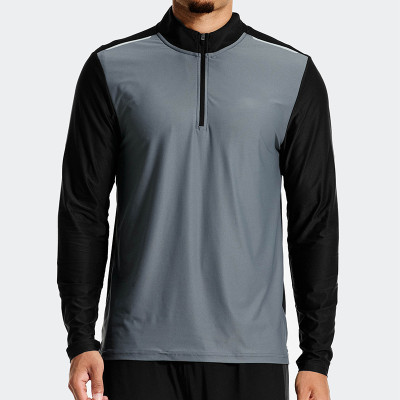
A fly-knit training top integrates multiple performance zones in a single garment without seam interruption: a denser, opaque front panel for structure and branding surface; open-mesh or perforated zones at the back yoke, underarm, and side panels for maximum ventilation; a rib-knit collar that transitions directly from the body fabric without a sewn neckband. The result is a training top with demonstrably better ventilation placement, zero seam-chafe at zone boundaries, and a construction that visually communicates technical sophistication at the point of sale.
Compression Base Layers and Performance Leggings
Fly-knit construction is the premium specification for compression base layers because it allows graduated compression — higher compression pressure at the calf, reduced at the knee, specific pressure at the quadriceps — to be engineered directly into the knit structure through variable stitch tension, rather than approximated through fabric cut and seam placement. A seamless compression garment produced by fly-knit construction applies medically accurate compression mapping across the leg without the pressure discontinuities created by sewn seam boundaries.
Running Vests and Trail Running Tops
For running vests and lightweight trail tops, fly-knit construction eliminates the underarm seam — the primary chafe point in long-distance running — by knitting the body and underarm panel as a continuous structure. A fly-knit running vest at 100–130 GSM in a nylon-polyester blend produces a finished garment weight of 80–120 grams — comparable to the lightest cut-and-sew alternatives but with zero seam contact at the underarm and shoulder positions across a full marathon distance.
Technical Polo Shirts and Performance Sportswear
In the golf, tennis, and premium sport lifestyle categories, fly-knit construction allows the collar, placket, and body to be engineered as a single knitted structure — eliminating the collar attachment seam that is the primary structural failure point and aesthetic compromise in standard polo construction. A fly-knit polo collar maintains its shape, roll, and dimensional precision across the full garment service life because it is structurally integrated into the body, not separately attached.
Engineered Socks and Compression Accessories
Fly-knit construction is the industry-standard method for technical sock and compression accessory production — the circular knitting technology that produces standard socks is a subset of the broader fly-knit category. For brands extending into the accessories category, engineered socks with zonal cushioning, arch support zones, and ventilation mesh produced by fly-knit construction are a logical and cost-effective extension of the same technology used in their performance apparel.
How Fabric Properties Determine Construction Choices
Fly-knit construction changes the nature of the construction decision — instead of selecting fabric and then determining how to assemble it, the designer and engineer specify the performance outcome at each body zone and the knitting program determines the fabric structure that achieves it. This inverts the standard development workflow.
Digital pattern file development
Before sampling begins, the fly-knit garment requires a digital knit design file — a programming document that specifies stitch type, yarn selection, needle bed configuration, and tension parameters at every coordinate of the knitted structure. This file is the technical equivalent of both the fabric specification and the pattern in a standard cut-and-sew workflow. Development of the file requires specialist knit engineering expertise and is the primary contributor to the extended lead time in fly-knit sampling.
At MontForge, fly-knit pattern file development is handled in-house by our knit engineering team. For brands submitting a performance brief or reference garment rather than a complete design file, our team translates the brief into a programmable knit structure — this service is included in the sampling process for fly-knit category projects.
Closure and assembly seams
Fly-knit construction eliminates seams at zone boundaries within the knitted panel — but it does not eliminate all construction seams. Final assembly requires closure seams at the garment's opening edges: typically the underarm side seam (on garments not fully seamless), hem, and any zipper or placket insertion. These assembly seams are constructed using micro-seam or bonded seam techniques — minimising bulk and maintaining the seamless visual language of the fly-knit construction throughout.
For fully seamless garments (produced on tubular circular knitting machines), assembly seams are limited to shoulder join and neckband attachment — the only positions where the tubular construction cannot close the garment without external seaming.
Branding integration in fly-knit construction
Fly-knit construction offers branding integration options unavailable in cut-and-sew construction:
· Knit-in jacquard branding: The brand logo, wordmark, or graphic is knitted directly into the fabric structure as a raised or inlaid jacquard pattern — no print, no transfer, no surface layer. The branding is structurally part of the garment and cannot wash off, crack, or peel. This is the highest-permanence branding method available in activewear.
· Tonal texture branding: A brand mark is created by contrasting stitch density or surface texture within a solid-colour knit — producing a visible pattern in certain lighting conditions without a colour contrast. Used extensively in premium sportswear for subtle, sophisticated brand identification.
· 3M reflective yarn integration: Reflective yarn — typically a plated reflective filament — is knitted into specific zones of the fly-knit structure at the pattern file stage, producing integrated reflective branding without a heat transfer application step.
For brands that require conventional branding methods (sublimation, heat transfer, embroidery) on fly-knit garments, these are applicable at the smooth-face zones of the structure — the same compatibility rules as standard active knit apply at those positions.
Zonal Design Principles for Fly-Knit Activewear
Effective fly-knit garment design requires understanding which body zones benefit most from specific knit properties — and mapping those zones to anatomically correct coordinates in the knit program.
Body Zone | Performance Priority | Correct Knit Specification |
|---|---|---|
Front chest | Structure, opacity, branding surface | Dense interlock or double-bed knit; 160–200 GSM equivalent |
Back yoke | Ventilation, heat dissipation | Open mesh or perforated single-bed; 80–120 GSM equivalent |
Underarm | Zero friction, maximum stretch | Fine single-jersey or miss-stitch panel; highest spandex ratio |
Side panels | Lateral stretch, body mapping | 4-way stretch single-bed; medium spandex content |
Shoulder | Load distribution, shape retention | Dense double-bed with minimal spandex; dimensional stability priority |
Collar and neckband | Shape retention, skin comfort | Rib stitch or dense jersey; no edge curl |
Sleeve | Freedom of movement, abrasion resistance | 2-way stretch; mid-weight yarn; smooth face |
Calf (compression) | Graduated pressure, recovery | Tightly controlled stitch tension; high spandex ratio |
This zone mapping is the starting point for fly-knit garment brief development — before yarn selection or machine specification, the performance brief at each anatomical zone must be defined.
Sourcing and Production Notes for Private Label Brands
Minimum Order Quantity: Fly-knit construction carries higher MOQ requirements than standard cut-and-sew active knit due to the machine programming setup cost amortised across the production run. MOQ varies by machine type (flat-knit vs. circular seamless) and yarn complexity. Contact the MontForge technical team for current MOQ by garment category and construction type.
Sample lead time: 15–25 days — the longest in the series. The extended window covers digital knit pattern file development (5–10 days), machine programming and setup, first-knit sample production, and dimensional and
performance evaluation. For brands submitting a reference garment brief rather than a complete design file, the development phase extends by 3–5 days for brief-to-file translation.
Bulk production timeline: 40–60 days. Fly-knit production is machine-speed limited — output per machine per day is lower than equivalent cut-and-sew production. Production scheduling must account for this throughput constraint when planning launch quantities and delivery windows.
Machine type selection: flat-knit vs. circular seamless The two primary fly-knit machine technologies produce meaningfully different garment constructions:
· Flat-knit (Stoll, Shima Seiki): Produces shaped panels — not fully tubular — that require assembly seams at shoulder and side positions. More flexible for complex zone mapping and garment geometry. Correct for performance tees, running vests, and technical poloshirts.
· Circular seamless (Santoni, Lonati): Produces fully tubular garments — no side seam. Correct for compression leggings, base layer tops, and fitted training shorts where zero side-seam contact is the construction requirement.
Pattern file intellectual property: The digital knit pattern file developed for a private label client's fly-knit garment is proprietary — it is not shared with other clients or used for other productions. MontForge treats client knit files as confidential design documentation under the terms of our standard NDA.
GRS-certified recycled yarn for fly-knit: GRS-certified recycled polyester and recycled nylon yarns are compatible with fly-knit construction across the standard denier ranges used in activewear — 50D–150D. Yarn consistency requirements for fly-knit are stricter than for cut-and-sew knit due to the machine tension sensitivity — GRS-certified recycled yarns must meet MontForge's yarn consistency specification before being approved for fly-knit production. Contact the sourcing team for approved GRS yarn options by denier and fiber type.
Summary: When Fly-Knit Is the Right Specification
Fly-knit performance fabric is the technically correct construction specification when the product brief requires:
· Zonal performance differentiation — different fabric properties at different body positions — without sewn seams at zone boundaries
· Seam elimination at high-friction anatomical positions: underarm, inner thigh, calf, shoulder
· A hero SKU that anchors the collection's technical credibility and commands a premium retail price point
· Knit-in branding — jacquard logo, tonal texture mark, or integrated reflective yarn — that cannot wash off or degrade
· Compression garments with anatomically graduated pressure mapping achieved through variable stitch tension
For high-volume core training garments where standard flatlock-seamed cut-and-sew construction meets the performance brief, Active Athletic Knit (Blog 07) is the more cost-effective and scalable specification. Fly-knit and standard active knit are complementary — not competitive — within the same collection.
Frequently Asked Questions
What is fly-knit fabric in activewear?
Fly-knit performance fabric is produced by computerised flat-knitting or circular seamless knitting machines that construct the garment panel or full garment geometry directly from yarn — without cutting and sewing separate fabric panels. The machine reads a digital design file and knits different stitch types, yarn weights, and fiber compositions into specific zones of the garment in a single continuous knitting process. The result is a garment with zero or minimal seams, variable performance properties across different body zones, and a construction that cannot be replicated by cut-and-sew assembly.
What is the difference between fly-knit and seamless knitting?
Seamless knitting is the broader category — it encompasses any knitting process that produces a garment or panel without cut-and-sew seam assembly at zone boundaries. Fly-knit is a specific implementation of engineered knitting that emphasises zonal performance differentiation through programmable stitch variation across the garment structure. All fly-knit construction is seamless at the knitted zone boundaries; not all seamless knitting incorporates the complex zonal programming that defines fly-knit. Circular seamless knitting (Santoni-type) produces tubular garments with no side seam; flat-knit fly-knit (Stoll or Shima Seiki-type) produces shaped panels requiring minimal assembly seams at shoulder and side positions.
Why are fly-knit garments more expensive than standard cut-and-sew activewear?
Fly-knit garments carry a higher retail price for three reasons: digital knit pattern file development (a specialist engineering step not required in cut-and-sew); higher machine capital cost (computerised flat-knit or seamless machines cost significantly more than standard cut-and-sew equipment); and lower production throughput (machine knitting speed is slower than fabric-cutting-and-sewing for equivalent garment volume). These three factors produce a higher cost-of-goods that must be reflected in retail pricing — fly-knit construction is correct for premium flagship SKUs where the construction complexity is a visible, communicable brand differentiator, not for high-volume basics where price sensitivity is the primary commercial constraint.
Can fly-knit garments be printed or embroidered?
Yes, with method-specific considerations. Sublimation printing and heat transfer are compatible at the smooth-face zones of a fly-knit structure — same compatibility rules as standard active knit. Embroidery is compatible at dense, dimensionally stable zones — not at open mesh or high-stretch panels where the knit structure cannot support embroidery frame tension without distortion. The most appropriate branding method for fly-knit garments is knit-in jacquard — the brand mark is integrated into the knit structure itself, making it structurally permanent and aesthetically consistent with the construction philosophy of the fabric.
What is the MOQ for fly-knit activewear production?
Fly-knit MOQ is higher than standard cut-and-sew active knit due to the machine programming setup cost. The exact MOQ depends on the machine type (flat-knit vs. circular seamless), yarn complexity, and number of colour or zone changes in the design file. Contact the MontForge technical team for a current MOQ matrix by garment category and construction specification — MOQ can frequently be reduced for brands that are launching a fly-knit hero SKU alongside a larger standard cut-and-sew core range within the same production programme.
How long does fly-knit sampling take?
Standard fly-knit sampling takes 15–25 days from brief confirmation to physical sample delivery — longer than the 7–12 days for standard active knit. The extended timeline is driven by digital knit pattern file development (5–10 days for brief-to-file translation and machine programming) and first-knit dimensional evaluation (2–3 days for measuring and approving the knitted panel geometry before the sample garment is assembled). Brands planning a fly-knit launch should build this extended sampling phase into their product development calendar.
MontForge is a verified premium men's activewear manufacturer with over eight years of production experience serving independent European and global private labels. Core product competencies span technical outerwear and shells, technical joggers and track pants, hoodies and sweatshirts, and gym and training wear. GRS-certified recycled material programs are available across all product categories.
Previous in the Performance & Lifestyle Fabrics series: Active Athletic Knit: The Workhorse Fabric for Training Shorts, Tees, and Base Layers
Next in the Performance & Lifestyle Fabrics series: Active Mesh Fabric: Breathability Zones, Weight Choices, and Ideal Applications